WhatsApp Business App vs WhatsApp API: What's the difference?


TL; DR: Quick Summary
- The WhatsApp Business App is free, caps broadcast lists at 256 contacts who've saved your number, and shares one number across at most 5 devices with no chat assignment.
- The WhatsApp Business API removes the 256 cap in favour of a rolling 24-hour recipient tier, connects unlimited seats through a shared inbox, and bills per message by category and country.
- WhatsApp Coexistence links both on one number, so a team can keep replying free from the app while campaigns, automation, and AI run through the API.
- Meta Business Agent runs inside the free app with no code needed; it does not require the API, though both versions bill on the same token meter.
- From 1 October 2026, service messages sent inside the 24-hour window become billable on the API side; the free app sits outside that charge entirely.
Most businesses that ask about the difference between WhatsApp Business and WhatsApp API aren't choosing a feature list. They're deciding who gets to reply, how far a message can reach, and what shows up on next month's Meta bill. The two products share a name and a green icon, and that's roughly where the resemblance ends.
This guide lays out the full comparison, the seven differences that actually decide which one a business needs, whether Meta Business Agent requires the API at all, and what changes for both on 1 October 2026.
The seven differences that actually decide it
Strip away the marketing language and the WhatsApp Business API difference comes down to seven numbers, not seven adjectives.
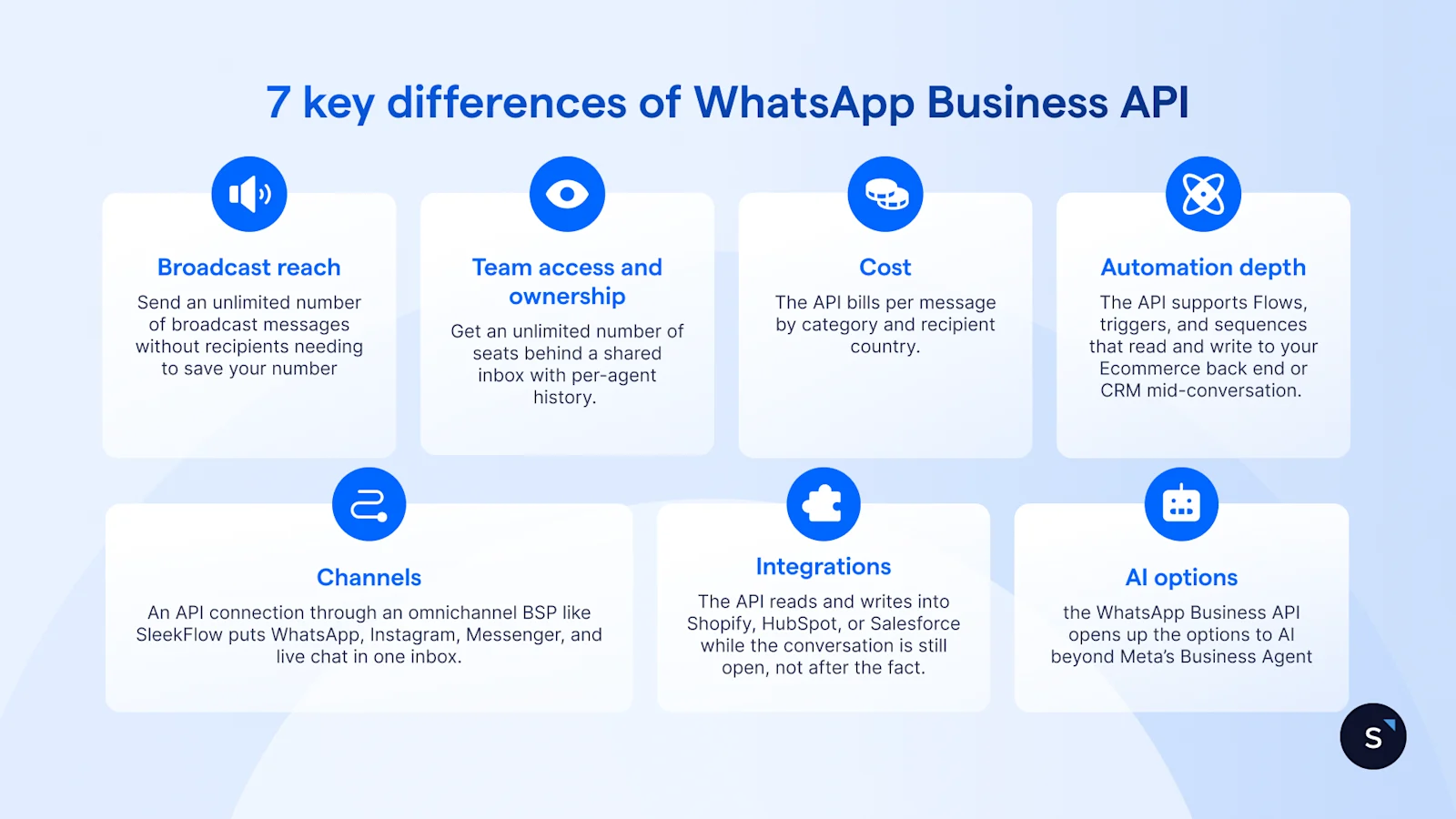
1. Broadcast reach. The basic WhatsApp Business app holds every list to 256 contacts, and only delivers to people who've already saved your number, with no way to confirm whether an unsaved contact actually received it. The API drops the list concept entirely: a new number starts at roughly 250 unique recipients per rolling 24 hours, then scales toward 10,000, 100,000, and unlimited as verification, quality, and volume increase.
2. Team access and ownership. The app links one number across a maximum of 5 devices, one phone plus four companions, and every linked device sees every chat with no way to assign a conversation or see who replied. The API puts unlimited seats behind a shared inbox with per-agent history.
3. Cost model. The app is free, full stop. The API bills per message by category and recipient country. In Singapore, a utility or authentication message runs about US$0.016, and a marketing message about US$0.0732; Malaysia's marketing rate runs roughly 17% higher. See SleekFlow's full WhatsApp Business API pricing breakdown for the complete rate card.
4. Automation depth. The app offers a greeting message and an away message, nothing that reads context or branches on an answer. The API supports Flows, triggers, and sequences that read and write to your Ecommerce back end or CRM mid-conversation.
5. Channels. The app is WhatsApp, and only WhatsApp. An API connection through a BSP puts WhatsApp, Instagram, Messenger, and live chat in one inbox, so a conversation that starts on one channel doesn't die there.
6. Integrations. The app has no way to see order history, loyalty status, or a support ticket. The API reads and writes into Shopify, HubSpot, or Salesforce while the conversation is still open, not after the fact.
7. AI options. Inside the app alone, there's no AI unless Meta Business Agent is switched on. From there, a business chooses between Meta's own agent (in either form) or a third-party AI agent like SleekFlow's AgentFlow, built to work across channels and systems rather than inside WhatsApp only. The full breakdown lives in Meta Business Agent vs AI agent: differences, cost and how to choose.
Do you need the WhatsApp Business API to use Meta Business Agent?
No. Meta Business Agent comes in two forms, and only one touches the API. The Meta Business Agent App runs inside the free WhatsApp Business app's Tools tab, needs no code, and learns from a business's past chats, Facebook Page, and website. The Meta Business Agent Platform is the developer-facing version, built for Cloud API numbers, where a business supplies knowledge through Business Info, FAQ, and file endpoints, and wires up its own actions through webhooks.
Same underlying agent, different amount of control. The app version answers; the API version can also act, triggering a booking or a payment through a custom endpoint. Both bill on the same US$2 per million token meter since 1 August 2026, and both are closed to 7 verticals: finance, government, health, alcohol, gambling, over-the-counter drugs, and matrimony services.
When the WhatsApp Business app is enough and when you need the Whatsapp Business API
When the WhatsApp Business app is enough
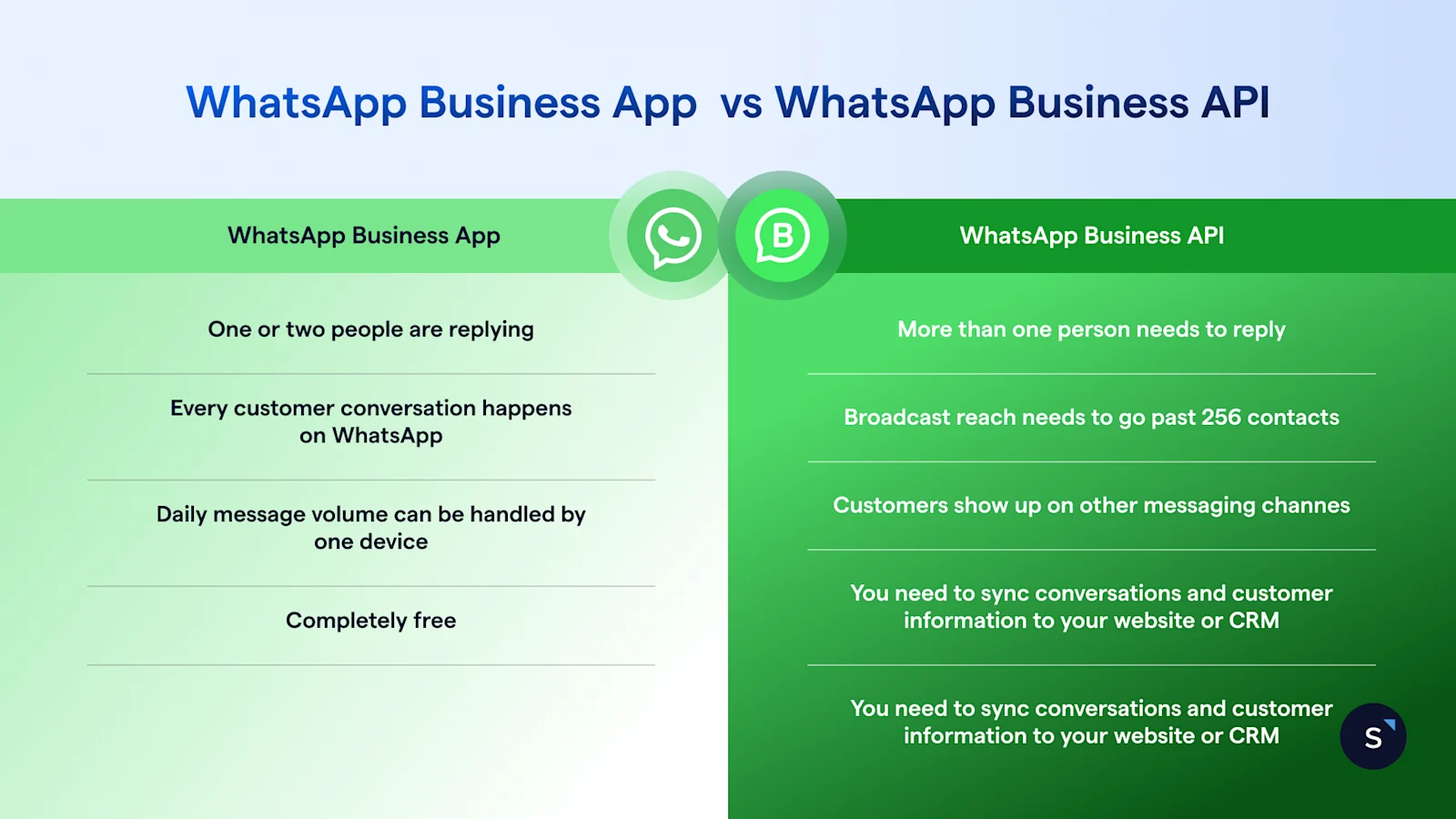
One or two people are replying, and that's every device the business needs to cover.
Every customer conversation happens on WhatsApp; there's no Instagram or Messenger volume to fold in.
Daily message volume stays inside what one phone and a few linked devices can handle without chats getting missed or double-answered.
From 1 October 2026, the app sits outside the new service-message charge entirely. That date changes nothing for an app-only business.
When you need the WhatsApp Business API
Broadcast reach needs to go past 256 contacts, or needs to reach people who've never saved the business's number.
More than two people are replying, and the business needs routing, assignment, and a record of who answered what.
Customers show up on Instagram or Messenger as well as WhatsApp, and switching inboxes to reply is costing time.
You need to sync conversations and customer information to Shopify, HubSpot, or Salesforce.
You want AI that can answer based on your CRM and website data.
How SleekFlow can help for your WhatsApp API needs
SleekFlow is a WhatsApp Business Solution Provider, so the API side of this comparison, Shared Inbox, Flow Builder, Broadcasts, and AgentFlow, runs on one platform instead of several. Shared Inbox gives unlimited seats and chat assignment past the app's 5-device ceiling. Flow Builder replaces away messages with sequences that branch on what a customer actually says. AgentFlow is SleekFlow's AI Agents product, built to read and write into Shopify, HubSpot, or Salesforce mid-conversation, across WhatsApp, Instagram, Messenger, and SMS from one agent.
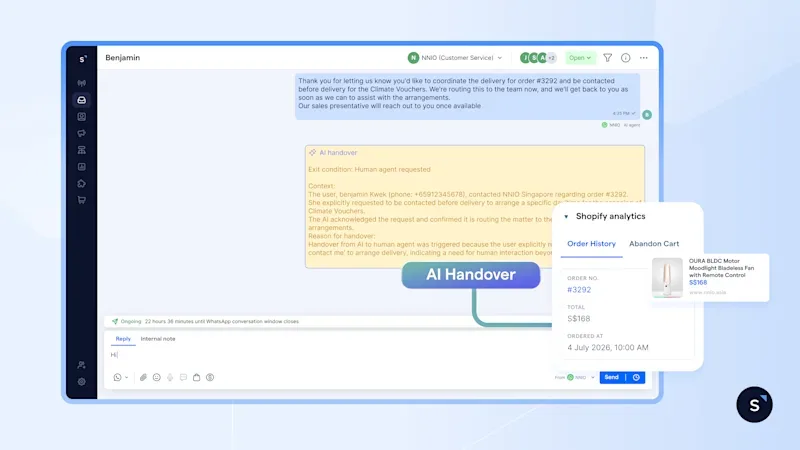
NNIO, a Singapore e-commerce business selling home appliances and cooling products, had customer enquiries split across four separate teams, with up to 50 messages going unanswered after hours during peak campaigns. It moved routine enquiries onto AgentFlow's AI Agents.
Results:
40% faster response time
30% of enquiries now handled by AI Agents
2.6x higher repurchase rate
Read the full NNIO case study →
Businesses that need Coexistence, keeping some staff on the free app while automation and AI run through the API, can set that up on the same number through SleekFlow's onboarding team.
See it for yourself
See how SleekFlow's AI agents turn conversations into revenue with AgentFlow.


