Loyalty programs: how they work, the types that convert, and how to build one that sticks


TL; DR: Quick Summary
- A loyalty program is a retention strategy that rewards repeat customers with points, tiers, or perks instead of one-off discounts.
- A 5% increase in customer retention can lift profits by 25% to 95%, the financial case for a loyalty program over paid acquisition alone.
- Points-based and tier-based structures dominate because customers already understand how they work.
- Most loyalty programs fail at the redemption stage, when members earn points they never cash in.
- Fixing redemption is a messaging problem, solved with automated reminders on the channel members actually check.
Your regulars have a stamp card, an app, or a QR code they scan out of habit. Pull the numbers, though, and half of them haven't redeemed a reward in months. The program is running. Nobody's collecting.
That's how most loyalty programs actually fail: not bad design, but a gap between points earned and points cashed in. The average Singapore shopper juggles memberships tied to yuu, GrabRewards, and half a dozen retailers at once, and most of those points just sit there.
This piece covers how a loyalty program works, which type fits your business, and why redemption, not enrolment, is where most programs break.
What is a loyalty program?
A loyalty program is a retention strategy that rewards repeat customers with points, tiers, or perks to encourage them to keep buying instead of switching to a competitor. Rather than chasing new customers, it turns purchase history into an ongoing relationship, using recognition as the reason to come back.
Most businesses already run something adjacent: a stamp card, a discount code for regulars, a WhatsApp list. A loyalty program formalises that instinct with visible rules, so customers know what they're working towards.
It's also not a permanent discount. A discount lowers the price for everyone. A loyalty program rewards behaviour, buying again, referring a friend, hitting a spend threshold- which builds a relationship a blanket markdown never does.
How does a loyalty program work?
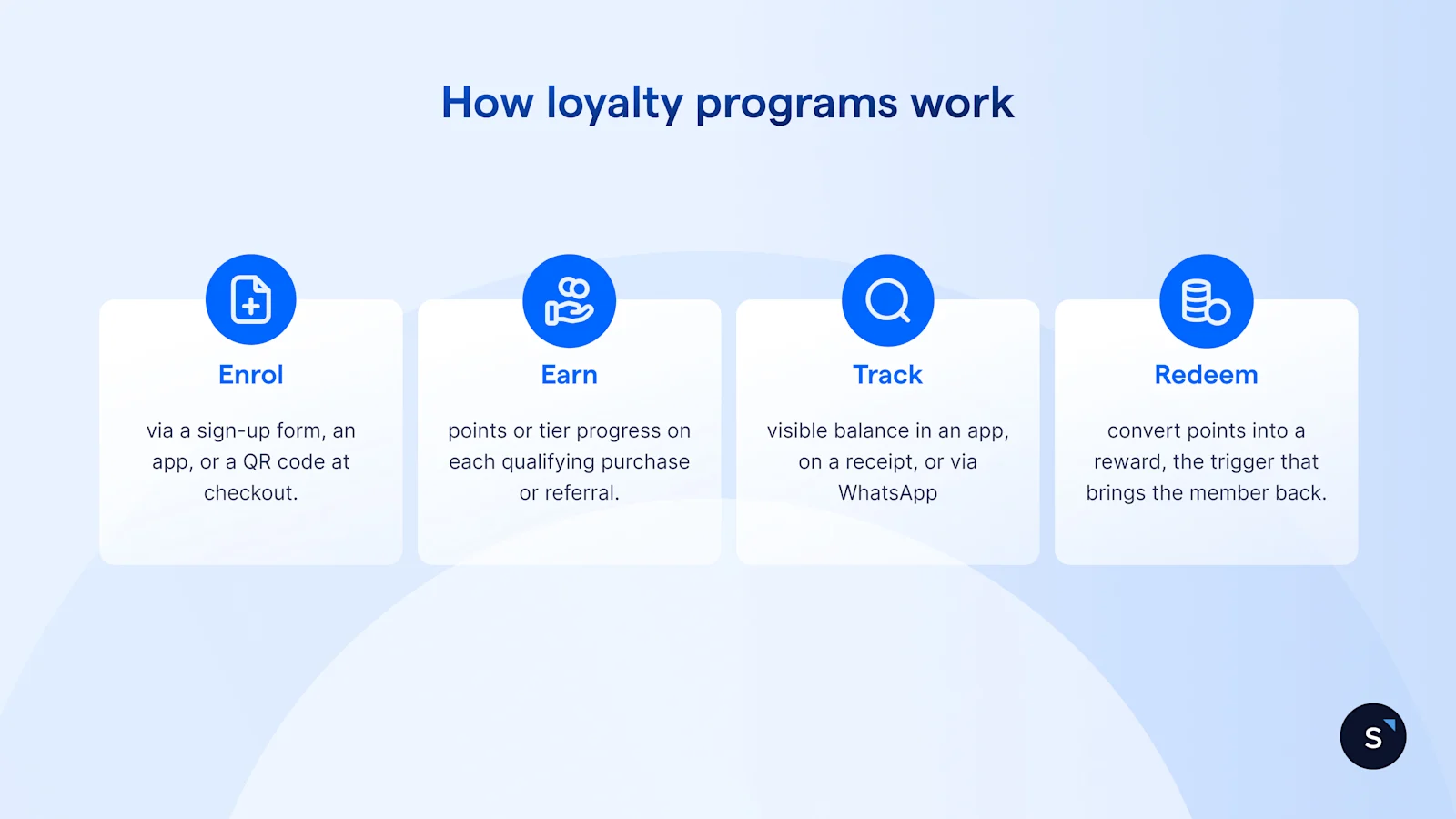
A rewards program works through four steps: a customer enrols, earns points or progress with each purchase, tracks a visible balance, then redeems it for a reward. Every step, especially redemption, needs to be easy to see and act on.
Enrol, via a sign-up form, an app, or a QR code at checkout.
Earn, points or tier progress on each qualifying purchase or referral.
Track, a visible balance in an app, on a receipt, or via WhatsApp.
Redeem, converting points into a reward, the trigger that brings the member back.
Many programs borrow game mechanics, a points meter, a streak, a badge, to keep that loop alive. Gamification doesn't replace the reward, but it makes earning feel like progress rather than paperwork.
What are the main types of loyalty programs?
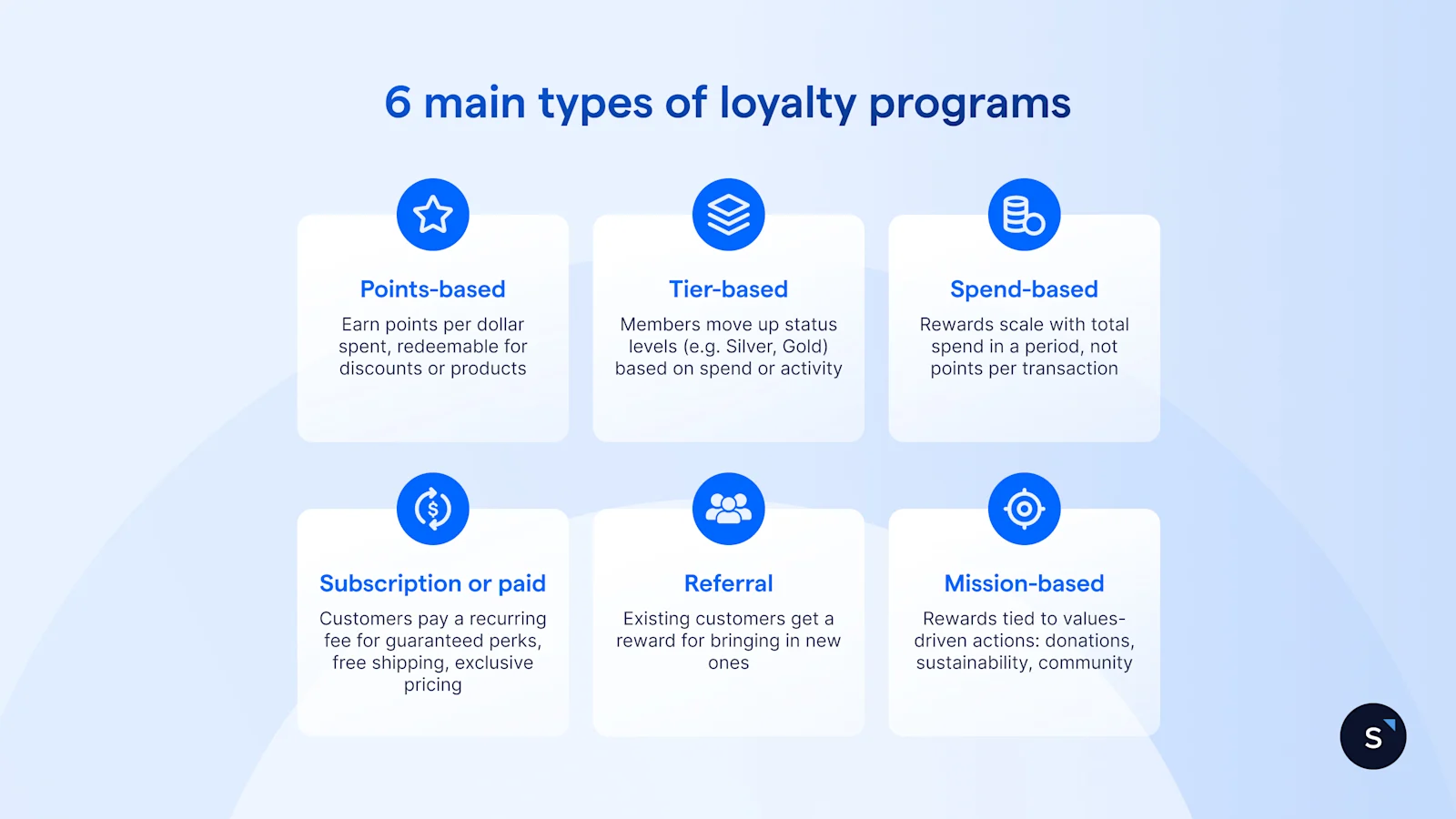
6 structures cover the ground here: points-based, tier-based, spend-based, subscription or paid, referral, and mission-based. The right pick depends on purchase frequency, margin, and how much status matters to your buyers.
What are examples of successful loyalty programs?
Successful loyalty programs share one trait: the reward matches how the customer already behaves. yuu Rewards Club in Singapore, Starbucks Rewards, and Sephora's Beauty Insider each reward a different pattern, and each retains members without competing purely on price.
yuu Rewards Club (Singapore). A points-based coalition program launched in Hong Kong in 2020 and Singapore in 2022. Members earn 1 point per S$1 across more than 1,000 outlets, including Cold Storage, Giant, Guardian, and 7-Eleven. That coalition structure is why yuu tied with NTUC's Link Rewards as Singapore's most-used loyalty program in a 2024 YouGov survey, ahead of GrabRewards. yuu's retail network spans grocery, health, beauty, and F&B, so members earn on almost every errand.
Starbucks Rewards. Stars earned per purchase, redeemable for free drinks. Seasonal "bonus Star" challenges add light gamification, giving casual customers a reason to open the app between visits.
Sephora Beauty Insider. A three-tier structure, Insider, VIB, Rouge, based on annual spend, with higher tiers unlocking early access and exclusive events, a reason to consolidate beauty spend with one retailer.
What are the benefits of a loyalty program?
A loyalty program pays off through 5 channels: retention, higher customer lifetime value (LTV), differentiation beyond price, word-of-mouth, and first-party data. A retained customer costs less to keep than a new one costs to acquire, and spends more once enrolled.
Retention. A 5% increase in customer retention can increase profits by 25% to 95%, per Bain and Company, since retained customers cost less to serve.
Customer lifetime value. Antavo's 2024 report found members who redeem personalised rewards show 4.3x higher annual spend, a direct line from redemption to LTV.
Differentiation. When competitors sell near-identical products at near-identical prices, genuine perks give customers a reason to pick one brand consistently.
Word-of-mouth. Referral mechanics turn members into an acquisition channel; recognised members recommend a brand unasked.
First-party data. Every enrolment and redemption is a data point on real buying behaviour, collected with consent.
Retention also beats acquisition on cost. Acquiring a new customer runs 5 to 25 times more expensive than retaining an existing one, per Harvard Business Review, the financial case for loyalty spend over new-customer ads alone.
How do you create a loyalty program?
Building a loyalty program takes 6 steps: set a goal, know your audience, pick the structure that fits, choose software that can track and message members, launch with a real push, then measure redemption, not just enrolment.
Set a goal. Repeat-purchase rate, average order value, or data capture, since the goal shapes the reward structure.
Know your audience. Real purchase frequency, average spend, and which channel they already use.
Pick the type. Match the structure to the buying pattern using the table above.
Choose software. It should message members automatically when a balance or deadline changes, not just hold a points ledger.
Launch and market it. Announce in-store, on receipts, and by direct message; brief staff to explain it in one sentence.
Measure what matters. Redemption rate and active-to-dormant ratio, not just sign-ups.
Why do loyalty programs fail, and how do you fix redemption?
Most loyalty programs fail from a redemption gap, not a rewards-design problem: members enrol, earn points, then forget the balance exists. A reward earned but never claimed delivers no repeat visit, just a line item sitting unused. Fixing it is a communication problem, solved with reminders on the channel members actually check.
Antavo's 2026 report found marketers now put 51.5% of total marketing budget into loyalty and CRM, with a 5.3x average reported ROI and 83% of owners satisfied with performance. Funding and design usually aren't the problem. The same report found only 3.4% of members actively opt out, meaning most dormant members are still reachable, sitting quiet rather than gone.
Fixing redemption doesn't need a rebuild. It needs the program to talk to members automatically: a message when they're close to a reward, a nudge before points expire, a tier-upgrade notification the moment it happens, all on a channel a member already has open, like WhatsApp, rather than a muted app notification or an email in a promotions folder.
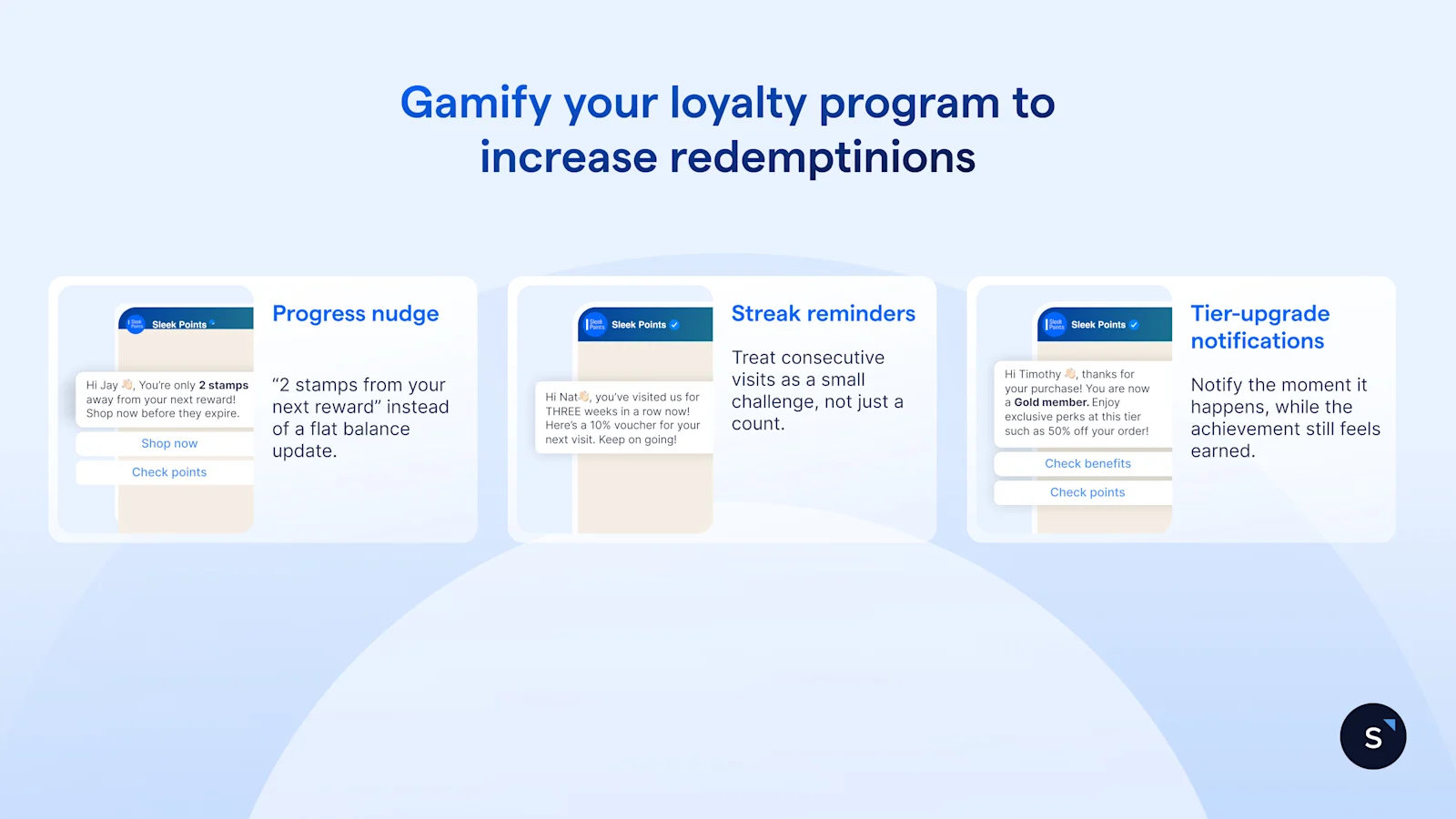
Gamified framing is what makes that message worth opening instead of muting:
A progress nudge, "2 stamps from your next reward," instead of a flat balance update.
A streak reminder that treats consecutive visits as a small challenge, not just a count.
A tier-upgrade notification the moment it happens, while the achievement still feels earned.
All three land better on a channel a member already has open, like WhatsApp, than as a muted app notification or an email in a promotions folder.
How SleekFlow keeps members engaged with automation and an AI agent
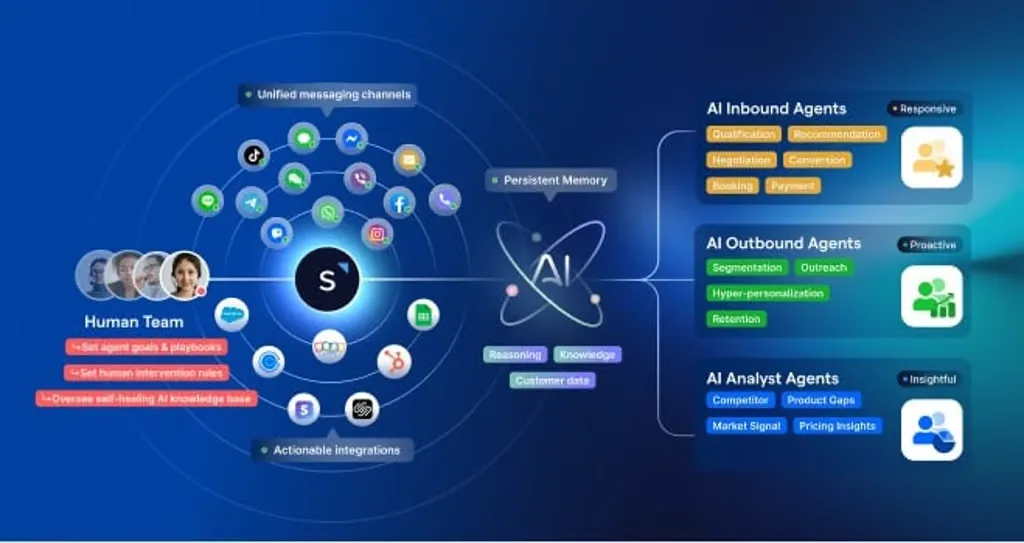
SleekFlow is the AI suite for revenue-driving conversations. For a loyalty program, that means automated reminders, tier-upgrade messages, and an AI agent that answers "how many points do I have" without a human touching the ticket.
Flow Builder triggers a WhatsApp or SMS message the moment a member crosses a points threshold, no manual list-pulling. AgentFlow, SleekFlow's AI agent product, answers balance and redemption questions inside that same conversation, handing off to a human only when needed.
NNIO, a Singapore e-commerce company across more than 90% of the country's major retail chains, hit a familiar problem: offline purchases went untracked, so retention efforts had no data to work from. Using SleekFlow's unified inbox, AgentFlow, and WhatsApp Flows to capture warranty registrations at the point of sale, NNIO closed that gap.
Results:
260% increase in retention rate
20% increase in completed checkouts
30% of enquiries handled by AI agents
See how SleekFlow automates loyalty messaging for your own program, starting with a conversation about how your members actually shop.
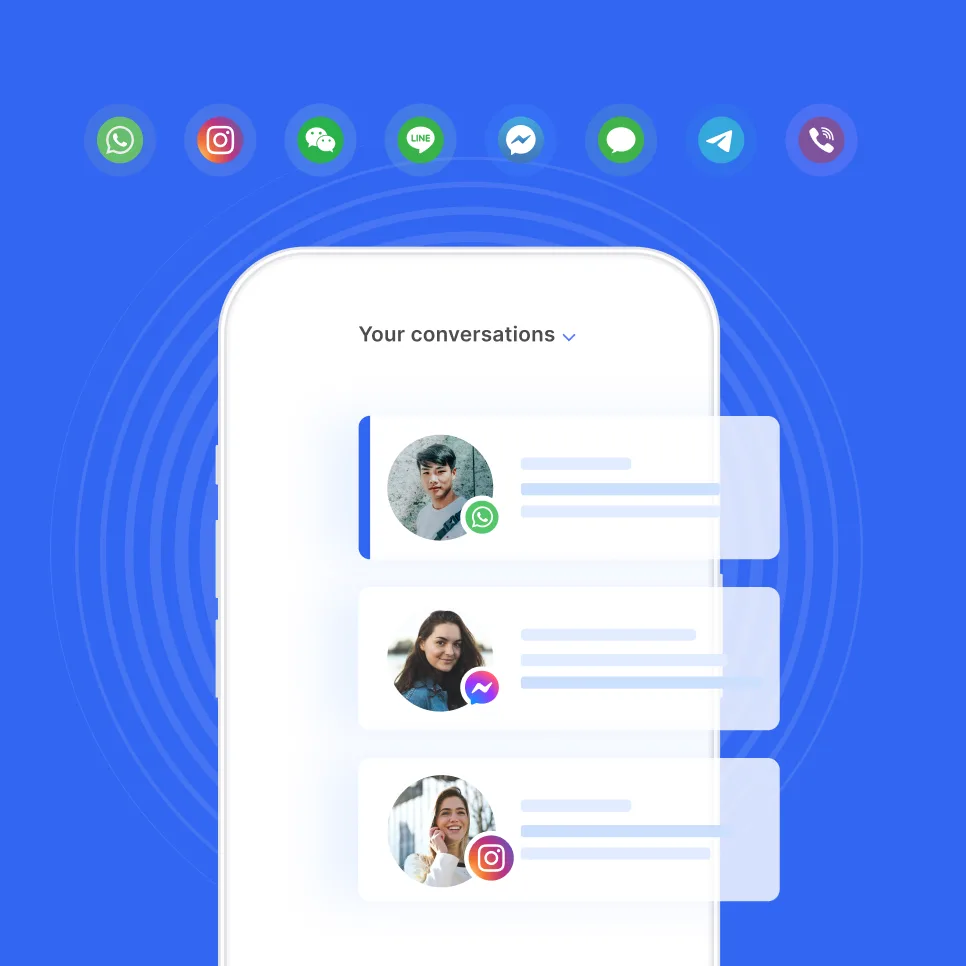
Want to outcompete your peers with SleekFlow's help?
Book your personalised demo with SleekFlow today and unlock the potential of seamless communication
Frequently Asked Questions
What is another name for a loyalty program?
What is the purpose of a loyalty program?
How much does it cost to start a loyalty program?
What types of loyalty programs are most effective?
How do you keep customers engaged in a loyalty program?
What is the difference between a loyalty program and a rewards program?
Recommended for you


