How to measure AI trustworthiness where it counts: the conversation


TL; DR: Quick Summary
- Learning how to measure AI trustworthiness means tracking two layers, model accuracy and the trust signals inside each live conversation.
- A high accuracy score will not stop an AI agent from destroying trust with a confident wrong answer to a billing question.
- Consumer trust in AI customer service sits at 55% when a clear human contact option exists, and around 25% without one.
- Singapore's Model AI Governance Framework for Agentic AI names human accountability as one of its four dimensions.
- Score four signals off any transcript: source transparency, calibrated uncertainty, graceful handoff, and auditability.
Keyword(s): how to measure ai trustworthiness Meta title (55/60 chars): How to measure AI trustworthiness in real conversations Meta description (137/150 chars): How to measure AI trustworthiness beyond accuracy scores, using the four conversation signals customers actually feel. Slug: how-to-measure-ai-trustworthiness Blog excerpt (15 words): Accuracy scores measure your model. These four conversation signals measure whether customers actually trust it.
Recommended SleekFlow blog links (for CMS internal linking):
Conversational AI for customer service in Singapore, covers escalation rules and PDPA governance, the operational layer beneath this article's trust signals.
How to train AI: optimising your documents for SleekFlow AI, the companion to source transparency, since grounding quality decides whether a citation means anything.
Introducing CX Intelligence, relevant to the auditability signal and continuous conversation review.
Your AI agent scored 94% on the evaluation set. Two weeks after go-live, a customer asks why her invoice went up by SG$40, gets a fluent and completely wrong explanation, and posts the screenshot.
Nothing in the pre-deployment test caught that. The model was accurate on questions it had seen, came apart on the one it had not, and gave the customer no signal that anything had changed. That gap, between measuring a model and measuring a conversation, is where trust is won or lost.
What does AI trustworthiness actually mean?
AI trustworthiness is a measurable property of a system that describes how reliably, transparently, and accountably it behaves, separate from whether users actually trust it. Singapore's AI Verify testing framework breaks it into 11 principles, including transparency, explainability, accountability, and human agency and oversight, assessed through process checks and technical tests.
The split between trustworthiness and trust does real work here. Trustworthiness is a property of your system: you can test it, document it, and put a number on parts of it. Trust is what a customer decides after an exchange, and no volume of internal documentation produces it on her behalf.
Quantitative vs qualitative: the two ways to measure AI trust
Quantitative measurement asks whether the model is right. Qualitative measurement asks whether people find its behaviour acceptable. Academic reviews of trustworthiness evaluation find neither works alone, and that the two pull against each other, with trade-offs between competing metrics such as fairness versus efficiency.
Both sets are pre-deployment work, or close to it. Neither watches a customer read an answer at 11 PM and decide whether to believe it.
Why benchmark scores don't equal customer trust
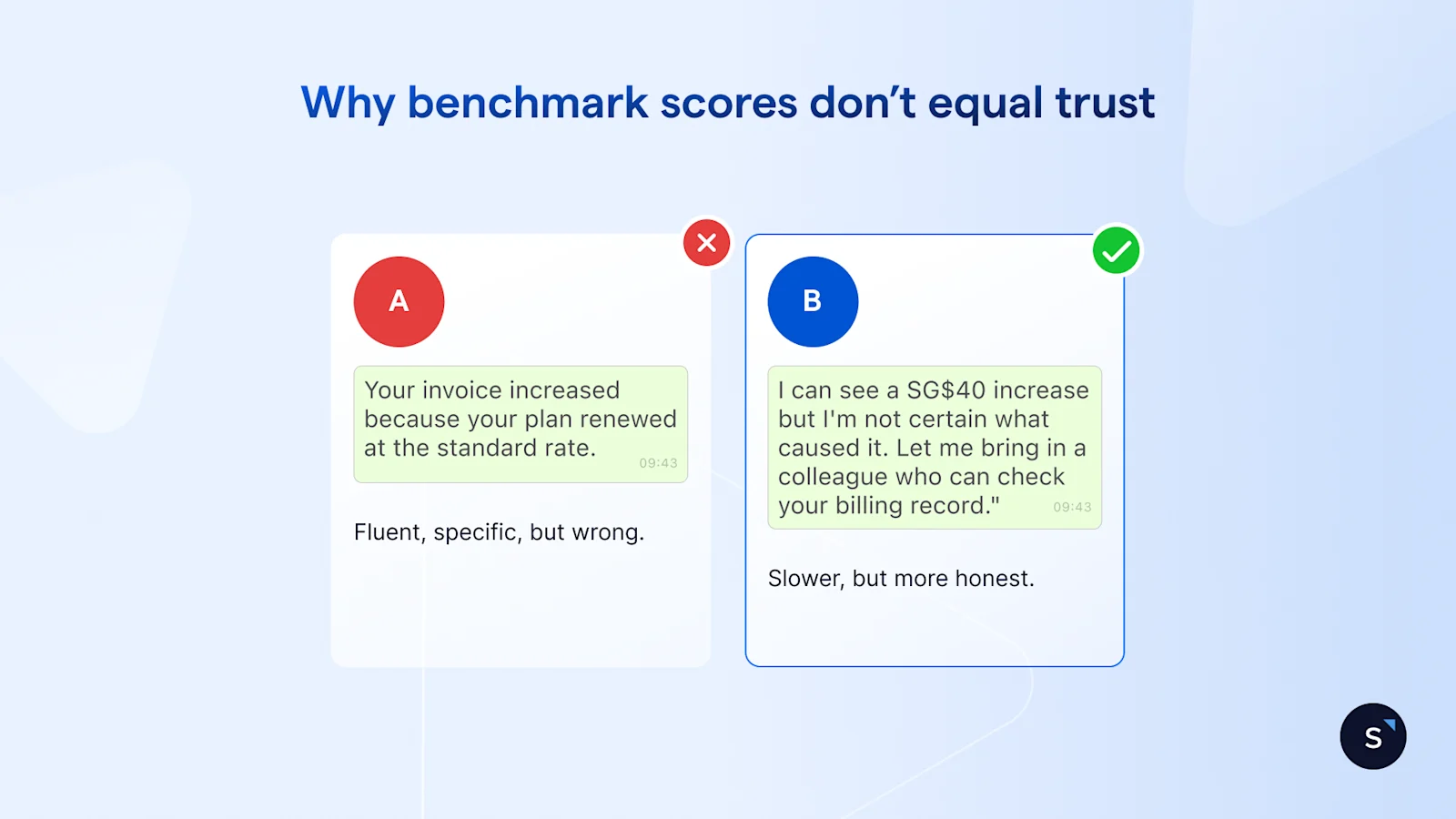
A benchmark is a closed test with known answers. A live customer conversation is open, unscripted, and often high-stakes, so a system can pass the first and fail the second. Benchmarks cannot tell a confident wrong answer from an honest admission of uncertainty, and customers register that difference immediately.
Back to the billing question:
Reply A: "Your invoice increased because your plan renewed at the standard rate." Fluent, specific, and wrong.
Reply B: "I can see a SG$40 increase but I'm not certain what caused it. Let me bring in a colleague who can check your billing record." Slower, and honest.
Most automated evaluations score Reply A as valid and may mark Reply B down as a non-answer. In the conversation, Reply A costs you the customer and Reply B keeps her.
Carnegie Mellon researchers testing four large language models found they grew more overconfident after performing badly, rather than adjusting downward the way people do. Gemini predicted 10.03 correct answers out of 20 on one task, scored fewer than one, then estimated afterwards that it had got 14.40 right. The study ran in Memory & Cognition on 22 Jul 2025.
Customers price this in. The same Five9 study of 3,000 consumers found 41% are less likely to buy from a company using AI for service, rising to 53% with no human fallback. Trust in deployment is earned by how the AI behaves when it is uncertain or wrong, which is exactly what pre-deployment metrics miss.
How to measure AI trustworthiness in a live conversation: four signals
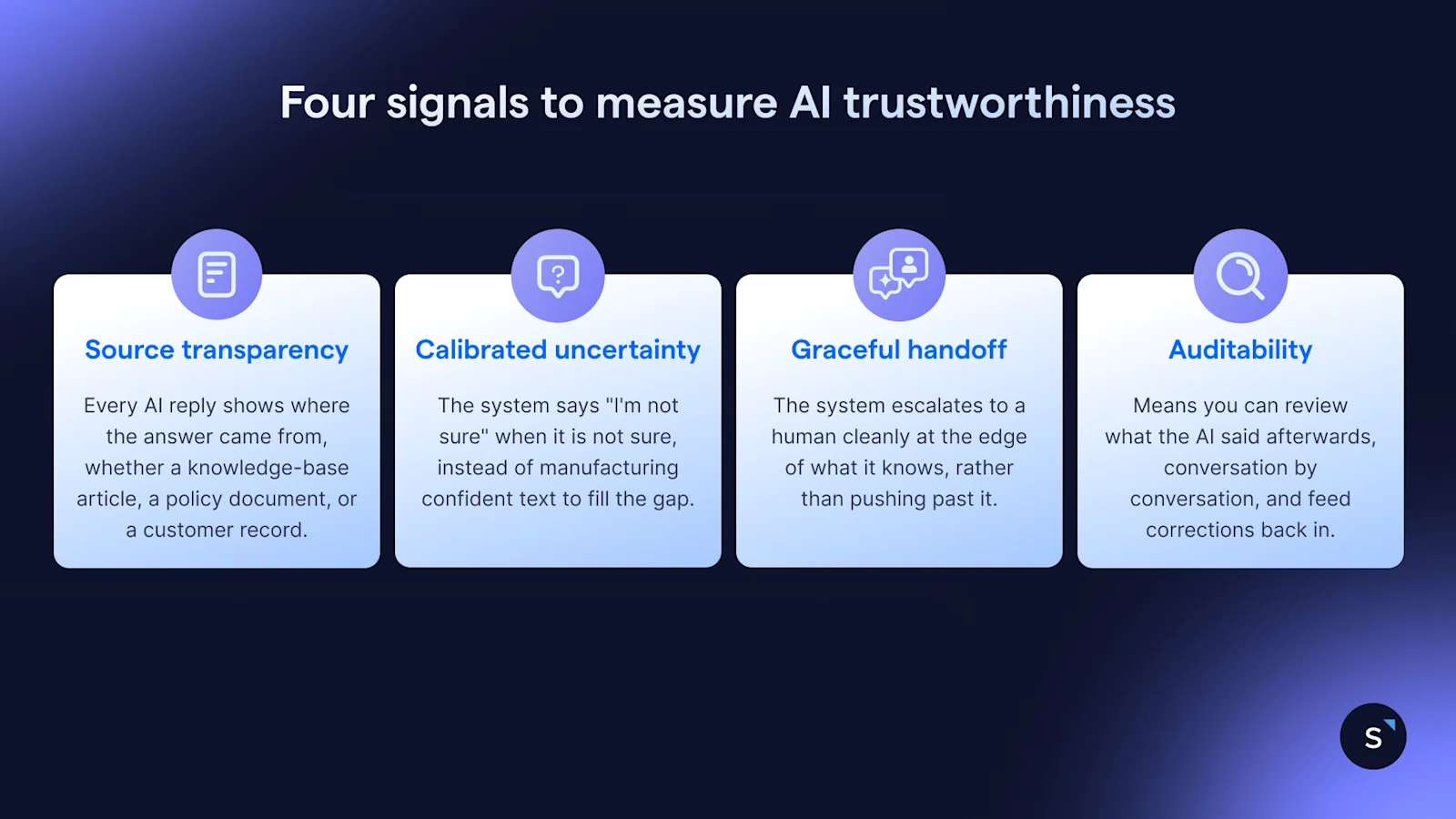
Four signals decide whether a customer acts on an AI answer or discounts it, and each one is observable in a transcript, so none needs a research project.
Source transparency
Source transparency means every AI reply shows where the answer came from, whether a knowledge-base article, a policy document, or a customer record. It turns an opaque answer into a checkable one, so a customer can verify it instead of taking it on faith, and an auditor can trace it later.
Calibrated uncertainty
Calibrated uncertainty means the system says "I'm not sure" when it is not sure, instead of manufacturing confident text to fill the gap. Given the Carnegie Mellon finding above, this is not a behaviour you inherit by default. You configure it, test it with out-of-scope questions, and monitor it after launch.
Graceful handoff
Graceful handoff means the system escalates to a human cleanly at the edge of what it knows, rather than pushing past it. The customer should never have to argue her way to a person. Since a clear human path roughly doubles consumer trust in AI support, this signal carries more commercial weight than any accuracy figure.
Auditability
Auditability means you can review what the AI said afterwards, conversation by conversation, and feed corrections back in. Without it, improvement is guesswork. Singapore's agentic AI framework treats this as baseline, calling for meaningful human control and oversight, and stating that humans remain ultimately accountable.
How to build organisational capacity for AI trust
Measurement without ownership decays. Singapore's agentic AI framework, published 22 Jan 2026, sets out four dimensions: risk assessment and limitation, human accountability, technical controls and processes, and end-user responsibility. Two of the four are about people and process rather than technology, which tells you where the effort sits.
Leadership commitment is more specific than a stated principle. It means a named owner for AI behaviour, a budget line for review time, and the authority to switch an agent off. The framework calls for checkpoints where human approval is required before an agent acts, which only works if someone has been handed that job.
Cross-functional review comes next, because engineers see model behaviour, compliance sees regulatory exposure, and CX sees what customers do afterwards. EY's AI Sentiment Survey 2026, covering 502 Singapore respondents, found 84% had used AI in the past six months while 71% worried that organisations fail to hold themselves accountable for negative AI use. Adoption is not the constraint. Accountability is. Pair that review with dashboards that flag performance and ethical drift as it happens, and write the thresholds that trigger a human before launch, not mid-incident.
How SleekFlow helps you measure AI trustworthiness
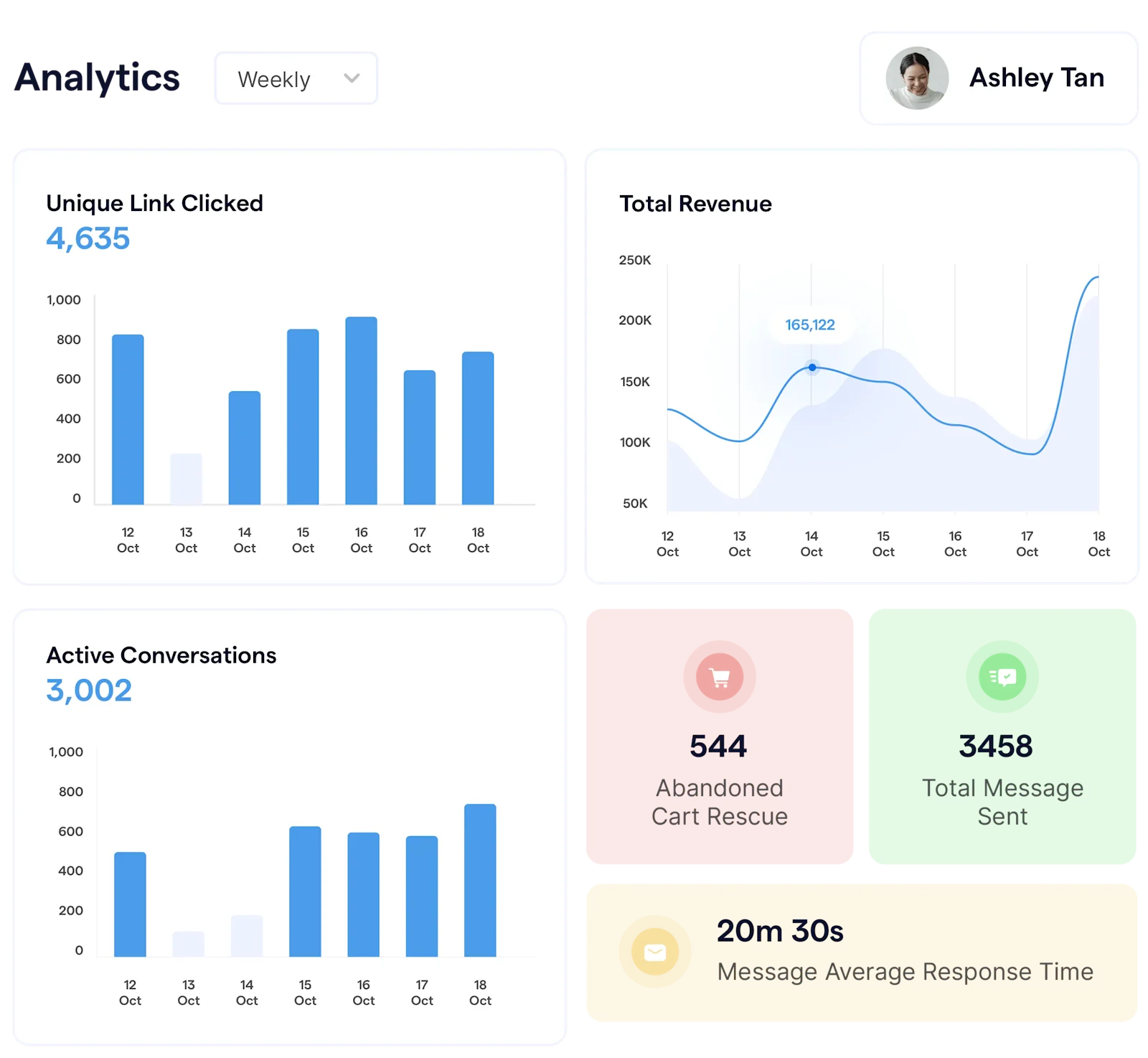
SleekFlow is an AI suite for revenue-driving conversations, and AgentFlow is the product inside it that runs AI agents across WhatsApp, Instagram, Messenger, and other channels.
On source transparency, AgentFlow shows the reasoning behind each response: the knowledge articles referenced, the playbook steps followed, and how it read the customer's intent.
On auditability, AI Agent Analytics reports the metrics above, including average conversation handover rate, exit occurrences by reason, and which data sources the agent drew on. On governance, SleekFlow holds ISO/IEC 42001:2023 certification for AI management systems alongside SOC 2 Type II and ISO/IEC 27001:2022, documented in the Trust Center.
NNIO, a Singapore e-commerce retailer selling home appliances and cooling products, ran support across four siloed teams with no shared view of a customer, and lost enquiries that arrived after hours. They deployed AgentFlow with a knowledge base trained on their own product pages and documents, plus handoff rules that pass a case to a person with internal notes already attached.
Results:
30% of enquiries resolved by the AI agent
40% faster response time
20% increase in completed checkouts
“Even though the customer knows that they’re speaking to an AI agent, they often thank us for the fast response, and also for the efficiency.”

Felicia Tan
D2C Growth Lead, NNIO
Start measuring the conversation, not just the model. Pull 50 transcripts from last week. Count how many replies carried a source, how many admitted uncertainty, and how many escalated with context intact. That number is your real trustworthiness baseline, and it will not match your evaluation score.
Want to outcompete your peers with SleekFlow's help?
Book your personalised demo with SleekFlow today and unlock the potential of seamless communication
Frequently Asked Questions
How do you measure AI trust?
Can a high-accuracy AI model still be untrustworthy?
What's the difference between quantitative and qualitative AI trust measurement?
What is Singapore's Model AI Governance Framework for Agentic AI?
How does source transparency build trust in AI?
Recommended for you


