What is customer analytics? A practical guide for businesses


TL; DR: Quick Summary
- Customer analytics is the process of collecting and interpreting data from customer interactions to understand behaviour, improve decisions, and drive growth across marketing, sales, support, product, and retention teams.
- Personalisation powered by customer analytics can lift revenue by 5 to 15% and improve marketing ROI by 10 to 30%, according to McKinsey, making it one of the highest-return investments a business can make.
- Most customer analytics programmes overlook conversational data (the questions, objections, and signals customers share on WhatsApp, Instagram DM, and other messaging channels), which is where buying intent is most clearly expressed.
- The four types of customer analytics (descriptive, diagnostic, predictive, and prescriptive) each answer a different business question, and most teams need all four to make reliable decisions.
- Tools like CX Intelligence can automatically surface insights from every customer conversation, removing the need for manual tagging or surveys to understand what customers actually want.
Most businesses have more customer data than they know what to do with. Website sessions, purchase records, support tickets, email open rates: it accumulates quickly. The harder problem isn't collection. It's turning that data into decisions.
Customer analytics is what closes that gap. This guide explains what it is, how it works in practice, which teams use it and how, and why the data source most businesses are ignoring, their customer conversations, is also the most revealing.
What is customer analytics?
Customer analytics, also called customer data analytics, is the practice of collecting, organising, and interpreting data from customer interactions to understand behaviour, identify patterns, and make better business decisions.
It draws on data from multiple sources (your website, purchase history, support tickets, email campaigns, and increasingly, messaging conversations) and applies analytical methods to answer questions your team can't answer from a spreadsheet alone: who is about to churn, what is causing your onboarding drop-off, which channel is actually driving your best customers.
Customer analytics isn't one tool or one report. It's a practice that runs across every team that touches the customer. When it's working, every decision (which campaign to run, which customer to call first, which product feature to build next) is grounded in something real rather than a gut feeling.
The four types of customer analytics
Not every data question calls for the same approach. Customer analytics typically breaks into four types, each answering a different level of the same question.
Most businesses start with descriptive analytics because it requires the least technical setup. The highest business value comes from predictive and prescriptive analytics, but those only work when your descriptive and diagnostic foundations are solid.
Why customer analytics matters
Businesses that act on customer data consistently outperform those that don't. The gap is measurable.
Personalisation driven by customer analytics can cut customer acquisition costs by up to 50%, lift revenues by 5 to 15%, and improve marketing ROI by 10 to 30%, according to McKinsey research. Companies that grow faster than their competitors generate 40% more of their revenue from personalisation than slower-growing peers. That gap doesn't come from having more data. It comes from using it.
The challenge most businesses face isn't motivation: it's that their data is scattered. Contact records sit in one system. Web analytics in another. Support tickets in a third. Messaging conversations in WhatsApp, Instagram DM, and Facebook Messenger don't feed into any of them. A McKinsey CEO survey found that while 63% of CEOs cite customer feedback as a key source for growth ideas, only 15% consistently integrate customer input into decisions.
Customer analytics gives you a way to pull these sources together and ask the questions that matter: not just "how many customers do we have" but "which ones are likely to leave, and why."
What customer analytics helps you understand
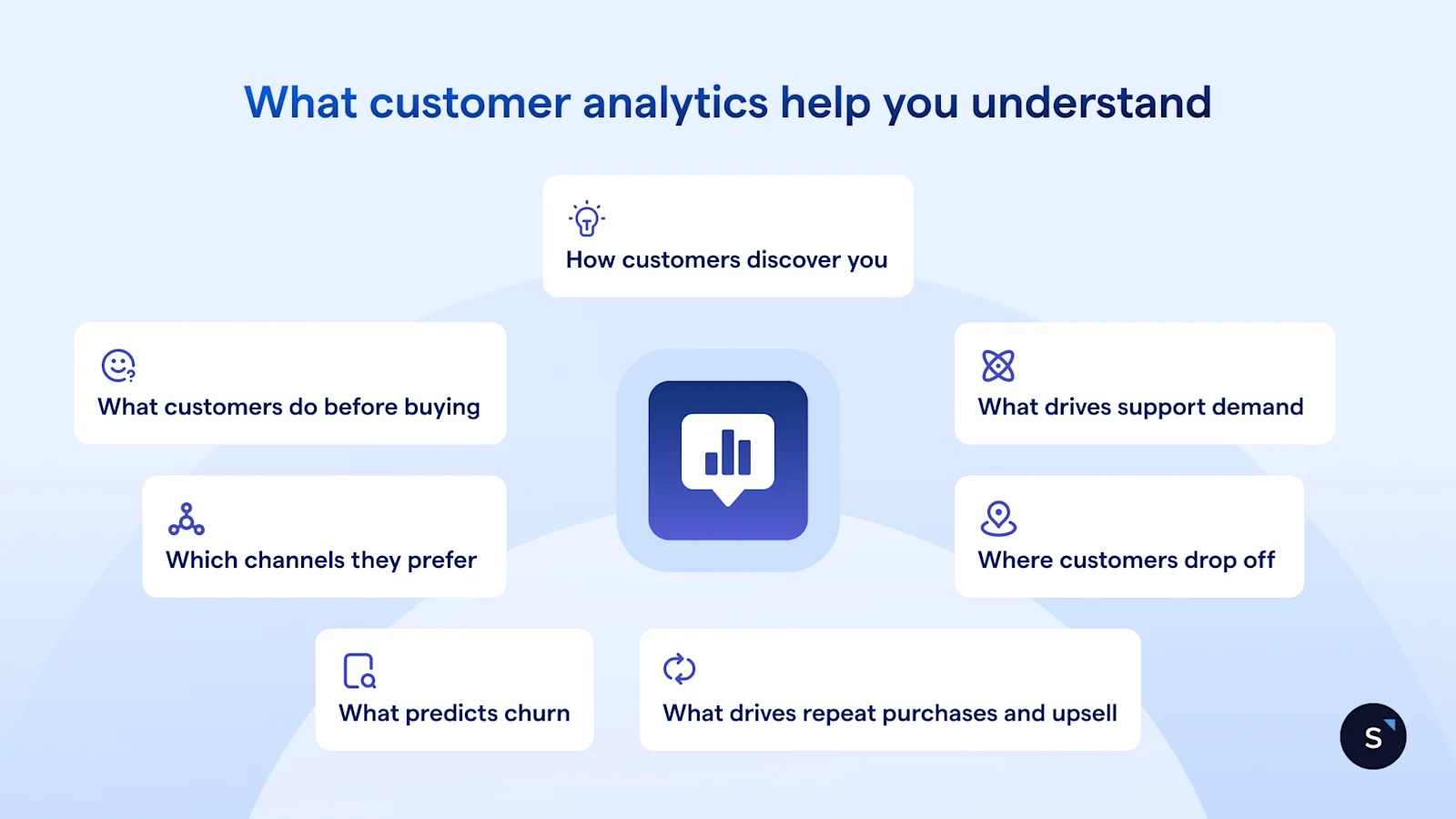
Good analytics answers business questions you couldn't answer by looking at any single data source. Here are the seven most valuable questions it can answer for a growing business.
How customers discover you. Which channels, campaigns, or referral sources bring in your best customers, not just your most common ones.
What customers do before buying. The pages they visit, the questions they ask, the content they read. This tells you where the real research phase happens.
Where customers drop off. The exact step in onboarding, checkout, or sign-up where a meaningful percentage of users disappear, and what the pattern looks like.
Which channels they prefer. Whether your audience responds better to WhatsApp, email, or Instagram DM, and whether that differs by segment, lifecycle stage, or product line.
What drives support demand. Recurring issue themes that point to a product gap, a knowledge base failure, or a pricing model that creates confusion.
What predicts churn. Behavioural signals that appear weeks before a customer disengages, so you can intervene before the decision is made.
What drives repeat purchases and upsell. The sequence of interactions, offers, or touchpoints that your highest-value customers have in common.
What data is used in customer analytics?
The quality of your analytics is a direct function of the quality and completeness of your data sources. Most businesses draw on a combination of these seven.
The last row on that table is the one most businesses are under-using. Customers ask their most honest questions in WhatsApp and Instagram DMs, not in surveys. That conversational layer holds signals that web analytics and purchase records will never capture.
How to set up your customer analytics workflow
Customer analytics follows a repeatable workflow. The specific tools change depending on your tech stack, but the stages stay the same.
Define the business goal. The question you're trying to answer shapes every subsequent decision. "Why are we losing customers in month three?" and "Which segment should we prioritise for an upsell campaign?" require different data and different analysis.
Collect the right customer data. Identify which sources hold the signals you need, and confirm you have the tracking in place to capture them. This is where many teams discover gaps, a missing UTM structure, or no logging on key conversion events.
Clean and categorise the data. Raw data is inconsistent. Duplicate contacts, inconsistent channel labels, and formatting differences all need to be addressed before analysis produces reliable output.
Analyse patterns and trends. Apply the appropriate analysis type: descriptive reporting, diagnostic root-cause analysis, predictive modelling, or prescriptive scenario testing. Most teams start with dashboards and move toward predictive tools as they build confidence.
Interpret what the patterns mean. Numbers don't interpret themselves. A drop in conversion rate on your checkout page could mean a UX problem, a pricing objection, or a traffic quality issue. The analytical step identifies the pattern; the interpretation step identifies what caused it.
Turn findings into actions. This is where analytics earns its return. A churn risk signal becomes a proactive retention message. A recurring support theme becomes an update to the product FAQ. A high-converting channel gets more budget.
Measure results and improve. Compare outcomes against your baseline and refine. Customer analytics is a loop, not a one-time project.
How different teams use customer analytics: real scenarios
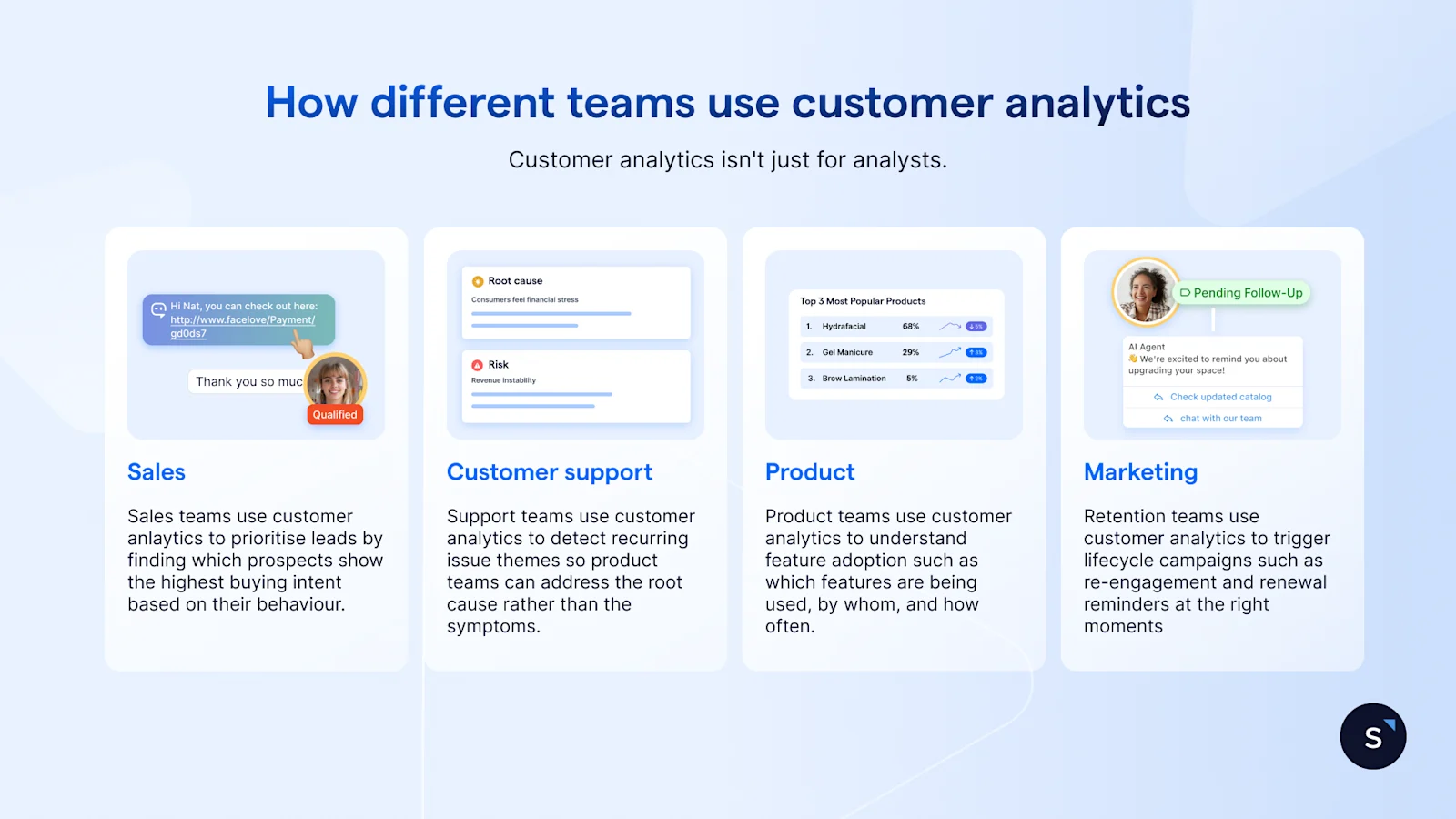
Customer analytics isn't just for analysts. Every customer-facing team uses it differently, and the value compounds when the data flows across teams.
Marketing
Marketing teams use customer analytics for segmentation (grouping customers by behaviour, lifecycle stage, or product interest), personalisation (sending the right message to the right segment at the right time), and campaign attribution (knowing which channels and messages actually drive revenue, not just clicks).
The most effective marketing teams also use predictive analytics to identify which inactive contacts are most likely to re-engage, so they don't waste budget broadcasting to an entire cold list.
Sales
Sales teams use customer analytics to prioritise leads (which prospects show the highest buying intent based on their behaviour), identify upsell and cross-sell opportunities (customers who have purchased Product A and show the behavioural patterns of Product B buyers), and understand where deals tend to stall in the pipeline.
Conversation analytics is particularly valuable for sales: the questions a prospect asks before buying reveal the exact objections the sales playbook needs to address.
Customer support
Support teams use customer analytics to detect recurring issue themes (so product and content teams can address the root cause rather than the symptoms), route incoming conversations more intelligently, and identify customers who are at churn risk before they escalate or disappear.
An analytics view across support conversations also reveals which channels your customers prefer for which types of issues, informing your staffing and automation strategy. SleekFlow's Performance Analytics Dashboard shows how teams can track response time, resolution speed, and agent performance across every messaging channel without manual reporting.
Product
Product teams use customer analytics to understand feature adoption (which features are being used, by whom, and how often), identify friction points in the product experience, and make prioritisation decisions about the roadmap that are grounded in actual usage data rather than the loudest voices in a feedback channel.
Marketing
Marketing teams use customer analytics to trigger lifecycle campaigns (re-engagement, loyalty rewards, renewal reminders) at the right moments, identify win-back opportunities for lapsed customers, and build a clearer picture of the behaviours that distinguish loyal, high-value customers from those who churn.
What tools are used for customer analytics?
No single tool handles every type of analysis. Most businesses combine several categories.
For teams operating primarily through messaging channels (WhatsApp, Instagram DM, Facebook Messenger), the conversation intelligence category is the most under-represented in a typical stack, and often the highest-value gap to close.
Why conversational data is becoming essential to customer analytics
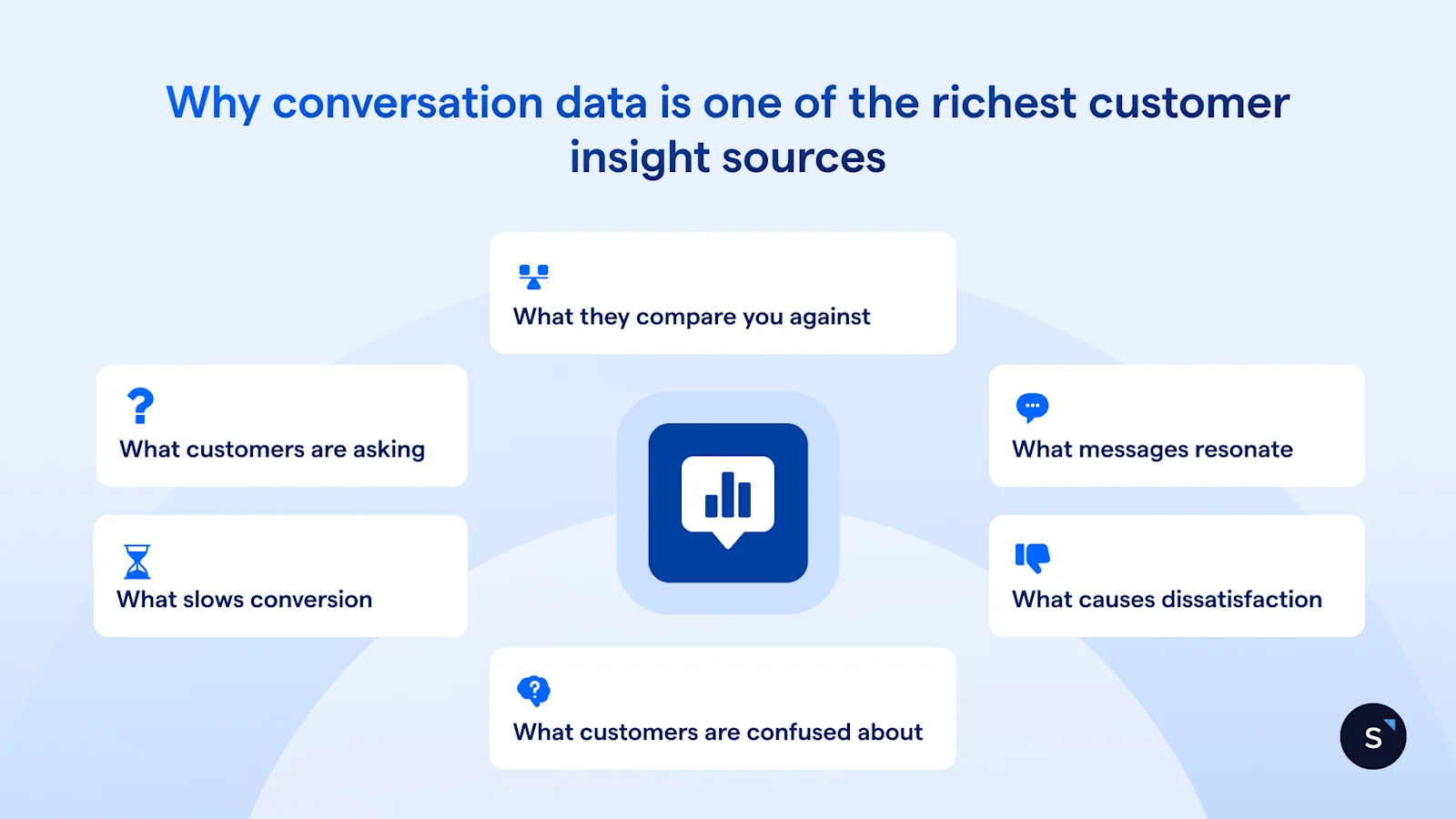
Most customer analytics programmes still focus on web behaviour and transaction data. That made sense when most customer interactions happened on a website. It makes less sense when your customers are messaging you on WhatsApp before they ever visit your product page.
Conversational data captures what other sources miss. A customer asking "Do you deliver to Jurong West?" before purchasing is telling you something about their buying criteria. A customer who asks the same question about a refund policy three times across two weeks is signalling a support experience that isn't meeting their expectations. A prospect who asks for a comparison with a specific competitor is in the final stage of a buying decision.
Web analytics records none of that. Transaction records don't capture it either.
What conversational data reveals:
Pre-purchase intent signals: the questions customers ask before buying, which tell you exactly what matters to them
Objection patterns: the concerns that repeat across your sales conversations, pointing to gaps in your messaging or product positioning
Confusion indicators: the things customers have to ask about repeatedly, which point to a documentation or UX gap
Satisfaction signals: expressions of positive or negative experience that appear in conversation but not in any formal feedback channel
Channel preference data: which customers initiate via WhatsApp versus email versus live chat, and how that maps to segment and lifecycle stage
As Gartner has projected that real-time analytics is becoming a baseline expectation rather than a premium capability for customer teams in 2026, the teams that get ahead will be those that expand their analytics scope to include the channels where customers actually communicate. For Singapore businesses in particular, where WhatsApp and Instagram DM are primary customer touchpoints, AI customer service analytics is where that expansion begins.
How SleekFlow turns customer conversations into customer analytics
SleekFlow's approach to customer analytics starts where most platforms stop: the conversation itself.
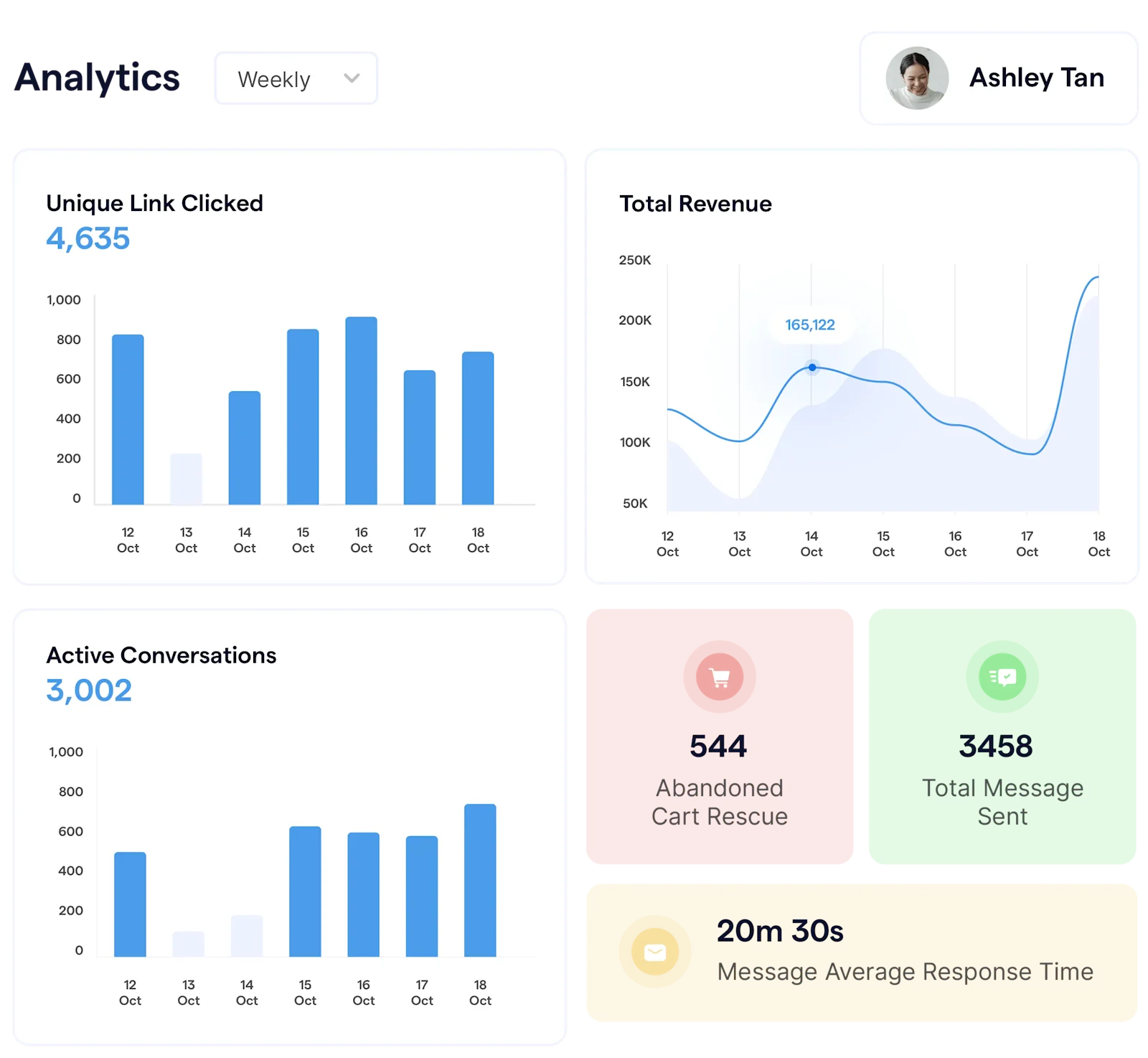
SleekFlow's Analytics Dashboard gives teams a unified view of conversation volume, response performance, conversion events, and customer interaction data across WhatsApp, Instagram, Facebook Messenger, TikTok Business Messaging, and other channels. Rather than treating each messaging platform as a separate data silo, it consolidates the signals into a single view that teams can act on. CX Intelligence takes this further: it automatically surfaces themes, intent patterns, and insights from conversations, without requiring manual tagging or periodic survey deployment.
Frequently Asked Questions
What is customer analytics?
Why is customer analytics important?
What is the difference between customer analytics and customer insights?
What are the four types of customer analytics?
What data is used in customer analytics?
How do businesses use customer analytics?
What tools help with customer analytics?
Can customer analytics improve customer retention?
Recommended for you


