AI customer service by industry: Real use cases for e-commerce, retail, hospitality, and education


TL;DR: Quick Summary
- The global AI customer service market hit USD15.12 billion in 2026.
- AI reduces first response times from over 6 hours to under 4 minutes on average, across industries.
- E-commerce and retail see the highest query deflection rates, above 50% in well-configured deployments.
- Hospitality businesses using AI see response times improve 3x or more, freeing staff for high-value guest interactions.
- The winning pattern across every sector is the same: AI handles volume, humans handle judgment.
The businesses that struggle with AI customer service are usually the ones that bought a generic tool and expected it to adapt. The ones that see results start by identifying their single highest-volume, most repetitive inquiry category, automate that first, and expand from there.
The pattern is consistent across sectors: AI handles the volume, humans handle the judgment. What changes is what "volume" means in your business. For e-commerce it's order tracking. For retail, it's omnichannel stock and returns queries. For hospitality it's the same 15 guest questions arriving from hundreds of rooms. For education it's enrollment inquiries that spike every intake season. Here's how it plays out in practice.
E-commerce: Resolving the same 9 questions at scale
E-commerce has the clearest AI customer service ROI of any sector. The reason is straightforward: roughly 80% of e-commerce support tickets are the same 9 questions. "Where's my order?" "Can I return this?" "Why was I charged twice?" Every one of those has a structured answer sitting inside Shopify or a 3PL integration.
The volume compounds this. During the 2025 holiday season, AI agents handled a 142% surge in support volume, including returns, shipping updates, order changes, with no additional headcount required. A human team that copes in January cannot scale to Black Friday without either hiring fast or automating the routine queries.
AI agents connected to Shopify or other e-commerce platforms handle order tracking, returns initiation, address changes, and stock queries without any human involvement. Resolution happens in seconds, not hours. There's also a pre-purchase case: AI chatbots can increase completed orders by 26% by answering product or shipping questions at checkout, right when a customer hesitates.
How Jakewell handles 300 - 400 weekly inquiries with SleekFlow
Jakewell, a Hong Kong baby products retailer selling across multiple e-commerce sites and social channels, was drowning in fragmented inquiries from WhatsApp, Instagram, and Facebook. After deploying SleekFlow, they:
Handle 300 - 400 customer care cases per week with faster resolution time
Automated keyword-based routing to the right specialist
Shopify-integrated order confirmations sent instantly via WhatsApp
SleekFlow is a platform that holds our relationship with customers close to heart. It helps us to connect with our customers more effectively for sales and marketing purposes, building a deeper level of trust and loyalty.

Phyllis
Digital Manager, Jakewell
Retail: The always-on sales floor
Retail's AI customer service challenge is different from pure e-commerce. Customers may start online, switch to in-store, and contact support via WhatsApp or Instagram DM, all for the same purchase. The fragmentation is the problem.
94% of retail companies say implementing AI has reduced costs, and the productivity numbers back that up. AI agents in retail cut first response time from 12 minutes to 12 seconds in documented cases, while reducing resolution time from over an hour to 2 minutes.
For retailers selling across multiple channels, the specific win is unified conversation management. When a customer messages on Instagram about a product they saw in-store, an AI agent can pull product details, check stock, and send a payment link - all without transferring to a human. For luxury and lifestyle retailers, who often have long pre-purchase conversations, AI handles the volume of early-stage inquiries so human staff can focus on the high-intent customers who need personal guidance.
How LUBUDS Group cut response time from 48 hours to 4 with SleekFlow
LUBUDS Group, a Hong Kong F&B and lifestyle retail group with nearly 40 outlets, had customer data scattered across brands with response times stretching up to 48 hours and marketing lists managed manually. Within three months of deploying SleekFlow's WhatsApp CRM and broadcast automation, they:
Cut average response time from 48 hours to 4 hours
Unified their customer database across all outlets
Launched targeted broadcast campaigns based on dining behavior and location, all from a single platform
SleekFlow's chatbot turns automated responses into a 2-way conversation. It is much easier to build a one-on-one relationship on WhatsApp than other methods, such as SMS.
Joyce Tse
LUBUDS Group Assistant Marketing Manager
Education: Handle enrollment spikes without burning out your team
Unlike most industries, education has a seasonality problem driven by enrollment. Within a matter of weeks, inquiry volume can multiply several times over, and the questions pouring in are always the same ones: what programs do you offer, what are the requirements, how much does it cost, when is the deadline. All of this lands on admissions teams that are already running at full capacity.
But the pressure doesn't stop when enrollment closes. Students have questions year-round about their timetable, how to submit assignments, and how to access campus. These follow patterns just as predictable as enrollment inquiries. AI agents trained on institutional FAQs resolve the majority without staff involvement, while escalating anything complex or sensitive to a human.
How Tutor Circle handles 1,000 daily inquiries with SleekFlow
Tutor Circle, a HK$8 million tutoring agency in Hong Kong managing 80,000 accredited tutors, was struggling to keep up with inquiry volume across their team. After deploying a WhatsApp-first strategy on SleekFlow, they:
Handle 1,000 daily inquiries
Achieved a 60% increase in efficiency
Reduced response time by 75%
SleekFlow web and mobile applications are stable, fast, and user-friendly compared to the WhatsApp Business app. Our maximum first response time is reduced from 4 hours to an hour. As a result, customer support efficiency has improved by 60%.

Andy Ng
Founder of Tutor Circle
Hospitality: personal service at scale
Hotels and resorts face conflicting demands. Guests expect personal, attentive service. But the operational reality is that the same questions arrive from hundreds of guests every week - "What time is check-in?" "Can I get an early check-out?" "Is there parking?" These are not complex service interactions. They're information delivery, and AI handles them well.
The staffing pressure compounds the problem. 65% of hotels in North America reported staffing shortages in 2025, while labor costs jumped 11.2% year-over-year. AI customer service isn't a nice-to-have in that environment; it covers the gaps that understaffed front-desk teams can't.
Practically, this means pre-arrival messaging, reservation confirmation, FAQ handling, and post-stay follow-ups running through an AI agent on WhatsApp — with human escalation built in for complaints, special requests, and anything requiring genuine judgment. Guests get instant answers at any hour. Staff capacity goes toward the interactions that actually shape a stay.
How Damar Langit improved response time 3x in one month with SleekFlow
Damar Langit, an Indonesian resort that expanded from F&B into full resort operations, needed a smarter way to handle reservation inquiries and qualify leads across social media channels. After deploying SleekFlow, they:
Improved CS response time 3x faster within one month
Increased sales conversions by 25%
Used auto-reply templates and CRM integration to distinguish new guests from returning ones, without manual sorting
SleekFlow enables us to connect with customers even faster. With templates, clients do not have to wait long for responses. It represents the Customer Care team to communicate more easily, and contribute to the revenue.

Maria Angelina Panjaitan
Customer Care
AI customer service playbook: where to start by industry
Not sure which workflow to automate first? Start here. Each row shows the highest-ROI entry point for your industry, the channel to deploy on, the metric to track in week one, and the early signs that tell you it's working.
Why SleekFlow for AI customer service
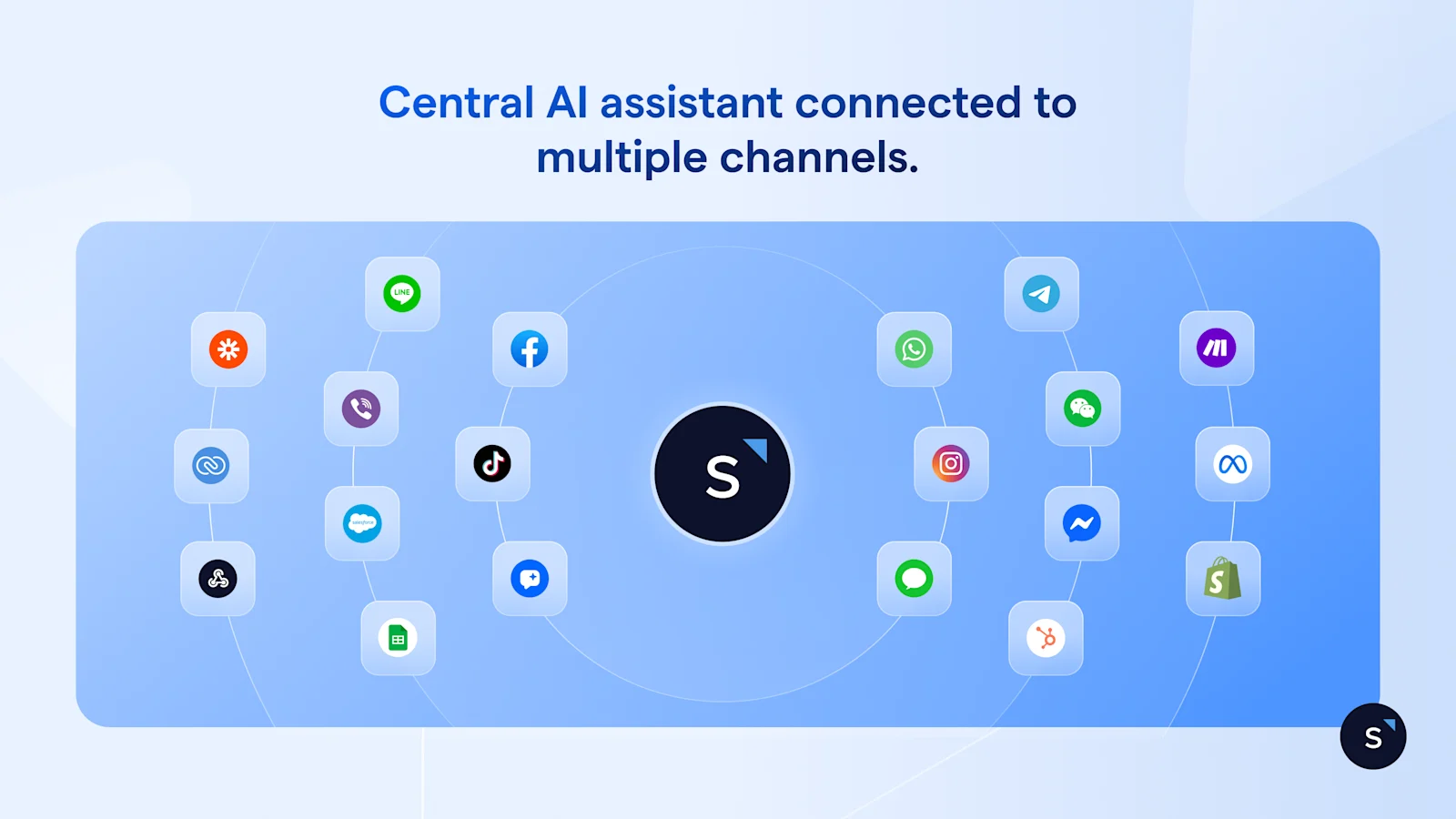
SleekFlow is an AI messaging platform, with WhatsApp, Instagram, Facebook Messenger, SMS, live chat, and more, all in one inbox.
Customers rarely stick to one channel. AgentFlow picks up wherever they are, qualifying leads, booking appointments, sending payment links, and routing to the right person, all inside the same conversation thread. No dropped context, no starting over.
The integrations go deep too. Shopify, HubSpot, and Salesforce connect natively, so the AI works from live data rather than a fixed script. As an official Meta Business Solution Provider, SleekFlow offers businesses direct WhatsApp Business API access and verified business account setup.
The results speak for themselves: brands using AgentFlow report 80% of conversations fully handled by AI, 2x more qualified leads, and a 150% lift in sales conversion rate.
Book a demo with SleekFlow and bring your highest-volume inquiry type. That's where the conversation starts.
Want to outcompete your peers with SleekFlow's help?
Book your personalised demo with SleekFlow today and unlock the potential of seamless communication
Frequently Asked Questions
How long does it take to set up AI customer service with SleekFlow?
How do I know which customer inquiries to automate first?
Will AI customer service hurt our customer satisfaction scores?
What's the difference between a chatbot and an AI agent?
Recommended for you


