Bulk WhatsApp vs Email Marketing in the UAE - Which Converts Better in 2026?


TL;DR: Quick Summary
- WhatsApp marketing has higher engagement in the UAE, with open rates of 80–98% compared to 12–30% for email.
- Email marketing remains important for B2B and long-form content, such as newsletters, guides, and lead nurturing.
- WhatsApp drives faster conversions, often generating responses within minutes.
- WhatsApp enables interactive communication, including chat, automation, and CTA buttons.
- Both channels must comply with UAE TDRA regulations, including opt-in and opt-out requirements.
- The best strategy is a hybrid approach: WhatsApp for fast engagement and email for long-term customer communication.
Introduction: The Growing Marketing Dilemma in the UAE
As the UAE continues to experience exponential growth in digital communications, marketers are increasingly focused on where to allocate their marketing budgets. With over 85% of the UAE population using WhatsApp daily, it’s no surprise that many businesses are considering bulk WhatsApp marketing as a primary tool. Yet, despite the rise in mobile messaging, email marketing still captures a significant portion of marketing spend. The question is: Which channel truly drives higher conversions in 2026?
In this post, we dive into the strengths and weaknesses of both WhatsApp and email marketing in the UAE context, looking at conversion rates, ROI, compliance challenges, and user behavior. Whether you're managing a small e-commerce store in Dubai or handling digital marketing for a major Abu Dhabi-based real estate agency, understanding these dynamics is crucial for maximizing your marketing efforts.
Why This Decision Matters in 2026
In 2026, the UAE digital landscape is rapidly evolving, with several key trends shaping how businesses approach marketing. These include:
Rising Customer Acquisition Costs (CAC): In competitive industries like retail, hospitality, and real estate, customer acquisition costs are rising rapidly due to the saturation of digital advertising channels. For marketers, ensuring that marketing dollars are spent wisely is more important than ever.
Strict Data Privacy and Compliance Laws: The UAE's Telecommunications and Digital Government Regulatory Authority (TDRA) has introduced more stringent privacy laws, particularly around customer data handling for digital marketing. Compliance with these laws is not optional, and marketers must be mindful of how they collect and use customer information.
AI Personalization: As AI technology becomes more advanced, personalization is expected to play an even more central role in customer communications. Marketers will need to adopt more intelligent, data-driven strategies to stay competitive.
Given these developments, businesses must evaluate which marketing channels will provide the best return on investment (ROI) while adhering to evolving compliance regulations.
Quick Comparison: WhatsApp vs Email Marketing
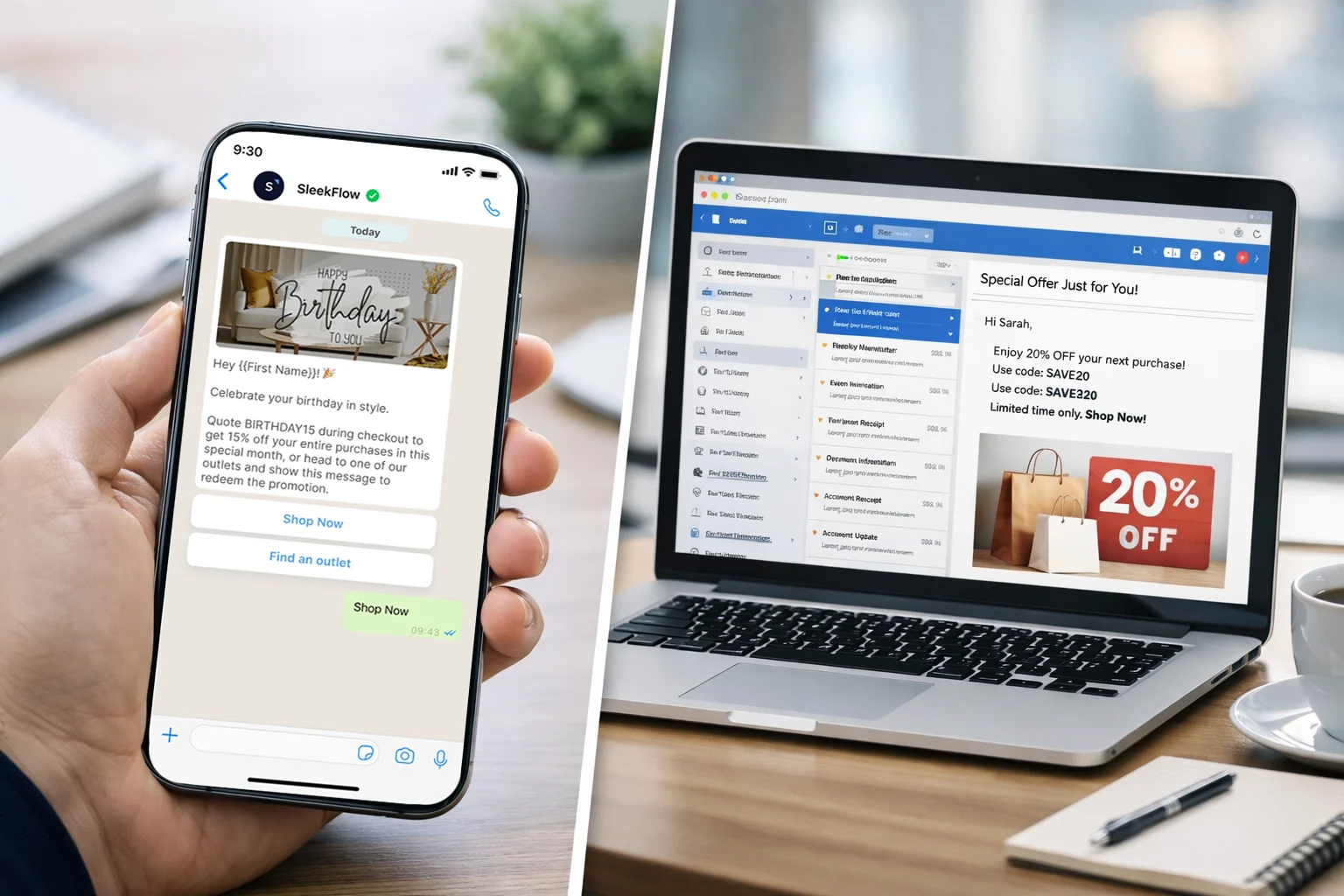
To make the decision easier, let’s compare WhatsApp and email marketing across several key performance indicators (KPIs) that matter most to marketers in the UAE.
Section 1: Understanding Bulk WhatsApp Marketing in the UAE
What Is Bulk WhatsApp Marketing?
Bulk WhatsApp marketing is a strategy that allows businesses to send large-scale communications using the WhatsApp Business API, such as personalized promotions, reminders, and customer service messages. This is done through platforms like SleekFlow, which streamline this process with advanced CRM integrations, automation flows, and AI chatbots.
In the UAE, WhatsApp marketing is especially effective for businesses looking to engage directly with consumers in a personal, real-time manner. The platform’s high penetration rate among both expat and local populations makes it an invaluable tool for marketers.
Why WhatsApp Performs Strongly in the UAE
WhatsApp is used by nearly everyone in the UAE, making it a dominant messaging platform. According to a report, WhatsApp usage in the UAE exceeds 85%, compared to lower rates for other apps like Facebook Messenger or Instagram. This makes it the go-to platform for businesses aiming to reach a broad audience quickly and efficiently. Additionally, WhatsApp is especially effective for:
Mobile-first consumers: The UAE has one of the highest smartphone penetration rates globally, with a high percentage of users relying on mobile devices for communication.
Expat communities: WhatsApp is the preferred method of communication for many expats living in the UAE, particularly for those who may not be familiar with other local digital platforms.
Real-time communication: Customers expect immediate responses, and WhatsApp is perfectly suited to providing instant replies.
Example: A Dubai-based F&B chain saw a 32% redemption rate from weekend promotions sent via WhatsApp broadcasts.
Strengths of Bulk WhatsApp
High Open Rates: WhatsApp messages in the UAE see open rates ranging from 80% to 98%, compared to the much lower open rates of email.
Immediate Delivery: Messages are delivered instantly and can generate quick responses, which is vital for time-sensitive offers.
Interactive Buttons: WhatsApp’s ability to include interactive buttons in messages (such as Call to Action (CTA) buttons) enhances user engagement and leads to better conversions.
Direct Sales via Chat: WhatsApp allows businesses to sell products directly through the chat interface by integrating e-commerce platforms, payment gateways, and CRM systems.
Verified Business (Green Tick): Businesses with the green tick verification gain customer trust, improving the likelihood of engagement.
Limitations of WhatsApp Marketing
Requires Opt-In: To comply with UAE regulations, businesses must get explicit consent from customers before sending promotional messages.
Template Approval: Meta requires businesses to use pre-approved WhatsApp templates for outbound messages, which can slow down the process.
Cost: WhatsApp operates on a conversation-based pricing model, meaning costs can quickly accumulate if the business sends high volumes of messages.
Section 2: Understanding Email Marketing in 2026
What Is Modern Email Marketing?
Email marketing in 2026 has evolved into a sophisticated tool used for automated sequences, customer nurturing, and personalized campaigns. Thanks to tools like Mailchimp, HubSpot, and ActiveCampaign, businesses can craft tailored email journeys that increase customer loyalty over time.
While email marketing may not offer the instant gratification that WhatsApp provides, it remains a critical tool for B2B communications and for businesses looking to engage with customers over longer periods.
Strengths of Email Marketing
Low Cost per Send: Email marketing remains one of the most affordable methods to reach a large audience. For businesses on a tight budget, it offers excellent value, especially with tools that automate segmentation and personalization.
Good for B2B: Email is still the preferred channel for B2B communications, particularly for lead nurturing and sharing detailed content such as whitepapers, case studies, and product guides.
Works Well for Newsletters: Email remains the ideal medium for long-form content and newsletters, where subscribers can engage at their own pace and digest more information.
Limitations of Email Marketing in the UAE
Lower Open Rates: Email open rates in the UAE continue to average between 20–30% in 2026, far lower than WhatsApp’s rates.
Spam Filtering: Many promotional emails end up in the spam folder or the promotions tab, meaning fewer people see them. With inboxes overflowing, this is a significant drawback.
Slow Response Cycle: Unlike WhatsApp, email tends to have a slower response cycle, which can delay time-sensitive campaigns or promotions.
Example: A UAE-based fashion retailer reported only 18% open rates and 1.9% conversion from an email campaign.
Section 3: Detailed Conversion Comparison: WhatsApp vs Email
Open Rates: WhatsApp vs Email (UAE Benchmarks)
WhatsApp’s open rate of 80–98% significantly outperforms email’s 15–25%. This is due to WhatsApp's instant delivery and the more personalized nature of its messages. Customers often open messages from WhatsApp instantly, while email is more passive.
Click-Through & Engagement Rates
WhatsApp’s interactive buttons and chatbot flows drive higher click-through rates (CTRs), reaching 15–45% compared to email’s typical range of 2–5%. This is particularly evident in the UAE, where mobile engagement is at an all-time high.
Speed to Conversion
For example, a flash sale in Dubai Mall saw a 4-hour sellout with a WhatsApp campaign, while the same campaign sent via email generated a 24-hour delayed spike in sales. WhatsApp’s ability to drive immediate action is unmatched in this case.
Section 4: When to Use WhatsApp vs Email (Decision Framework)
Use WhatsApp If:
You need fast conversions and urgent communication.
Your business is consumer-facing and operates on a mobile-first basis.
You need to engage directly with customers for promotions, reminders, or sales.
Use Email If:
You have long-form content that needs to be shared over time.
You’re engaging in B2B marketing, particularly for lead nurturing or customer education.
You’re focusing on email newsletters, detailed product guides, or event invitations.
Section 5: Compliance in the UAE
Both WhatsApp and email marketing are subject to the TDRA compliance framework. Businesses must adhere to the following:
Explicit opt-in from customers.
Easy opt-out procedures.
No unsolicited bulk messaging for sensitive industries like real estate and finance.
For real estate agencies, for example, unsolicited WhatsApp messages could violate TDRA regulations if they are not properly consented.
Conclusion: The Best Strategy for 2026
In the UAE, WhatsApp is the clear winner for fast conversions and high user engagement, particularly in consumer industries like retail, hospitality, and F&B. However, email marketing still holds value for long-term nurturing.
The most effective marketing strategy in 2026 is a hybrid approach: WhatsApp for immediate conversions and promotions, and email for nurturing and educational content.
Case Studies
ETS Global
ETS Global, a global education assessment provider, improved student engagement by shifting from traditional email marketing to WhatsApp using SleekFlow. By leveraging WhatsApp broadcasts, AI automation, and real-time messaging, the team was able to communicate more effectively with Gen Z audiences. As a result, ETS Global achieved a 63% increase in engagement, higher reply rates, and improved operational efficiency through automated responses and better campaign optimization.
We noticed there's a lot of changes in customer preferences, especially with Gen Z's. So they prefer instant kind of communication rather than traditional channels like email marketing. So this is mainly the reason why we decided to go with WhatsApp.

Sarah Masri
Marketing & Communications Assistant
Read the full story of how ETS Global boosts engagement by 63% by shifting from email to WhatsApp with SleekFlow and AgentFlow.
Nafsi Health
Nafsi Health, the UAE’s first fully DHA-licensed online psychiatry and psychotherapy platform, used SleekFlow to improve patient communication through WhatsApp. By implementing automated workflows, centralized messaging, and CRM integrations, Nafsi was able to manage sensitive patient conversations more efficiently while keeping interactions personal and supportive. This WhatsApp-first approach helped the company build trust with patients, improve response times, and increase conversions, ultimately enabling Nafsi to scale its patient engagement while maintaining a high-quality care experience.
We thought everyone would go to the app, but it was actually when we launched first with WhatsApp and then moved to an app, we saw an uptick in our convergence, so WhatsApp is king in the region.

Tyeb Hassan
Co-Founder | Nafsi Health
Read the full story of how Nafsi Health builds trust and drives conversions with seamless WhatsApp communication on SleekFlow.
Want to outcompete your peers with SleekFlow's help?
Book your personalised demo with SleekFlow today and unlock the potential of seamless communication


