AI personalisation: how it works and where it's used


TL; DR: Quick Summary
- AI personalisation tailors content, recommendations, and replies to each individual, then adapts as behaviour changes.
- Rules-based personalisation applies fixed logic to segments; a model re-scores each person in real time.
- 74% of Asia Pacific consumers already use AI to shop, yet 32% still hold back personal and payment data.
- Two separate PDPC advisory documents apply in Singapore: one for recommendation systems, one for generative AI.
- Start with one high-value channel and data you already trust, not every touchpoint at once.
You open the weekly campaign report and the same 10% discount code went to the shopper who pays full price every month and to the one who has not opened an email since March. The segment was right. The person was not.
Closing that gap is what AI personalisation is for. Below: what it is, how the loop works, where Singapore brands use it, and the PDPC guidance to note.
What is AI personalisation?
AI personalisation is the use of artificial intelligence to tailor content, product recommendations, and interactions to each individual rather than to a segment. It analyses behaviour, preferences, and context, predicts what a person is most likely to want next, and adapts in real time as it learns from every interaction.
The difference is scale. One good salesperson remembers 50 regulars and what each buys. A model working from the same signals does that for 500,000 people, on every channel, at once.
You will meet the US spelling abroad: IBM defines AI personalization as using AI to tailor messaging, recommendations, and services to individual users.
How does AI personalisation work?
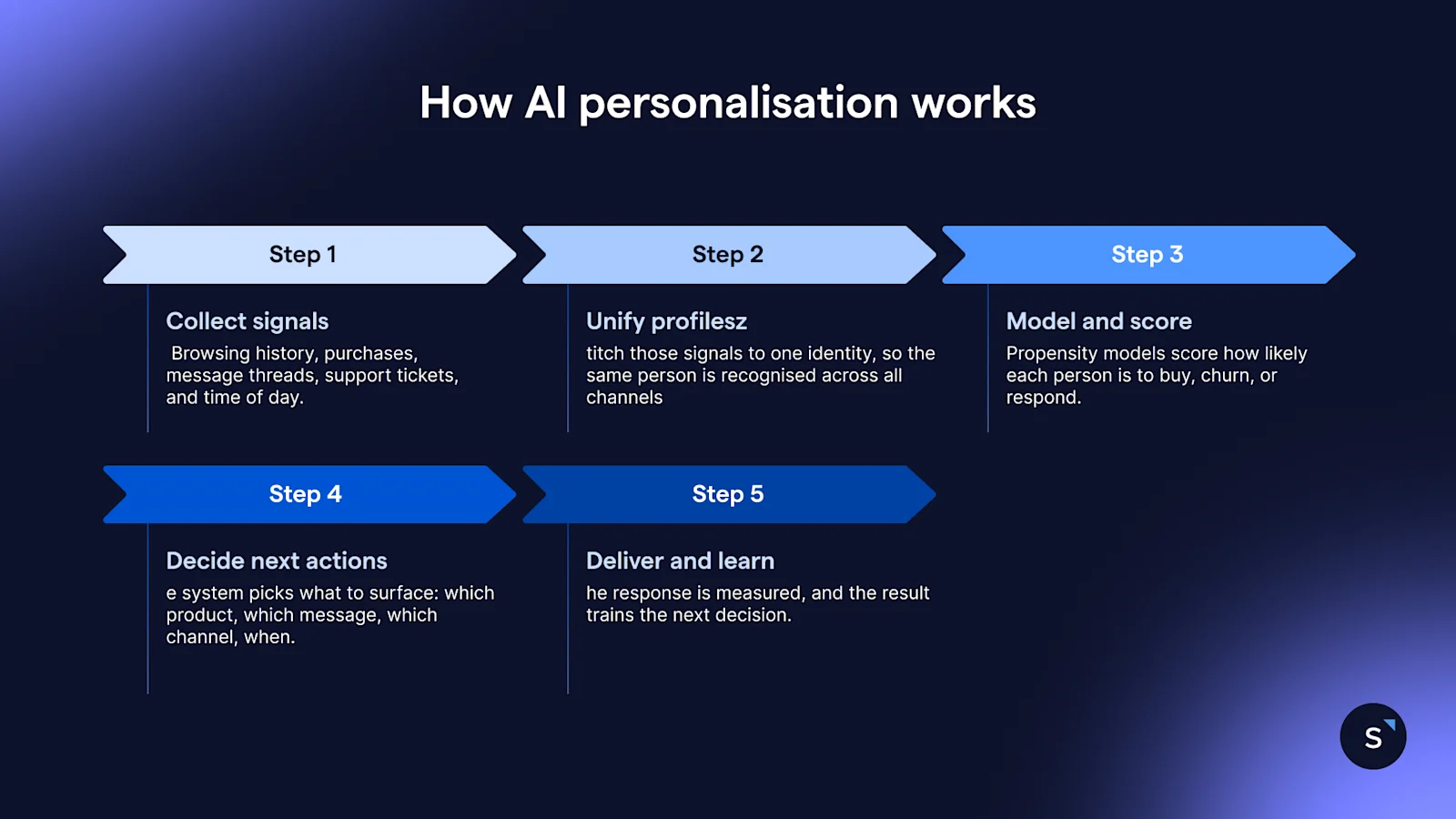
It works as a loop: collect signals, unify them into one profile, model what the person is likely to want, act on that prediction, then feed the outcome back as training data. Each cycle sharpens the next, which is why these systems improve with use.
Collect signals. Browsing history, purchases, message threads, support tickets, and time of day.
Unify profiles. Stitch those signals to one identity, so the same person is recognised on WhatsApp, on the website, and in store.
Model and score. Propensity models score how likely each person is to buy, churn, or respond.
Decide next actions. The system picks what to surface: which product, which message, which channel, when.
Deliver and learn. The response is measured, and the result trains the next decision.
Rules-based vs AI-driven personalisation
Traditional personalisation runs on rules a human writes; AI-driven personalisation runs on patterns a model finds. A rule fires identically for everyone who matches it, and changes only when someone edits it. A model re-scores each person as new behaviour arrives, so two customers in one age bracket get different offers.
Use rules where the answer must be fixed and auditable, such as delivery cut-offs. Use a model where it depends on the person.
Where is AI-driven personalisation used?
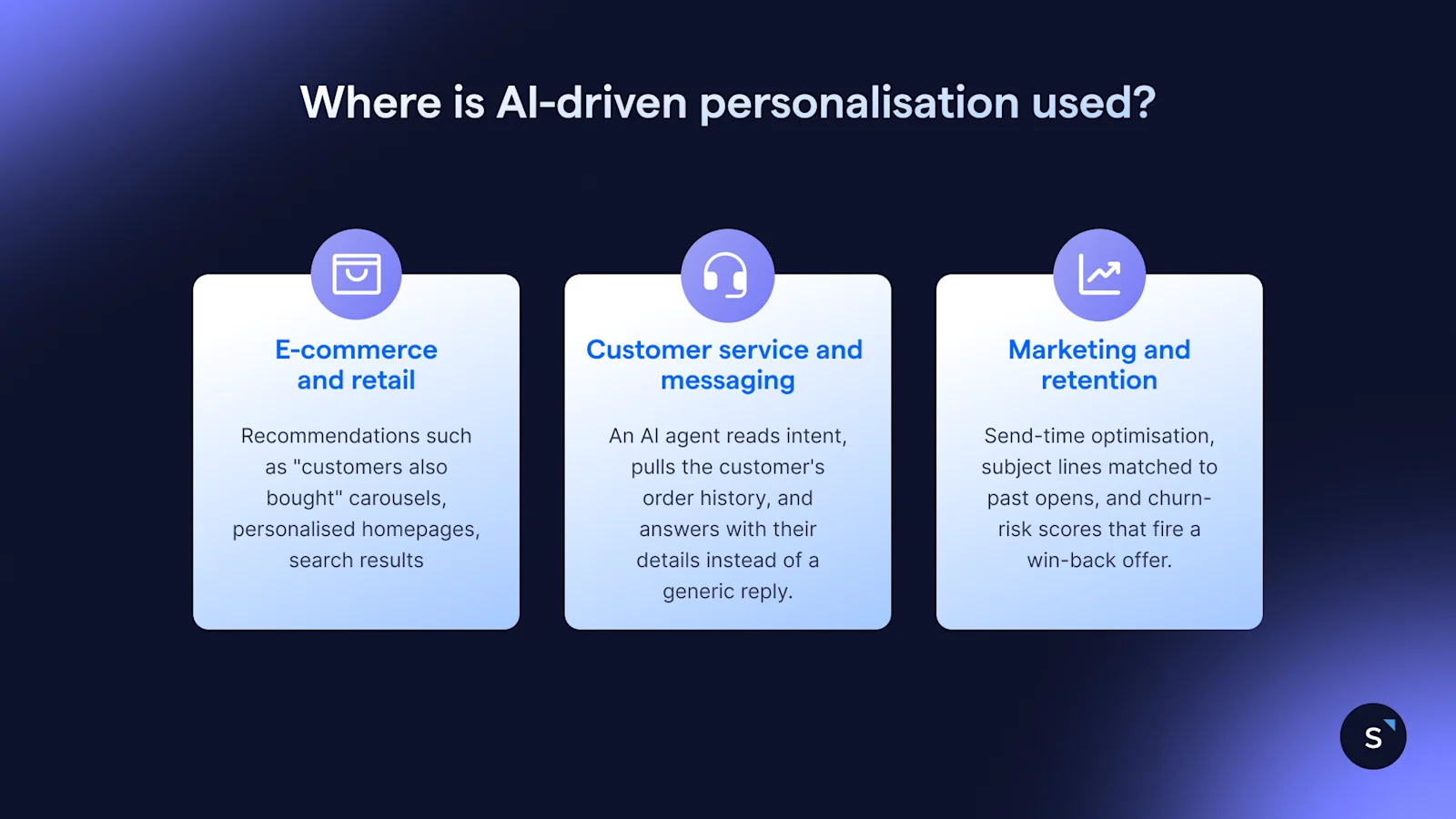
It shows up wherever there is enough behavioural data to learn from, which today means retail, financial services, streaming, travel, education, and customer service. The mechanics stay the same: score the individual, pick the next action, measure, repeat.
E-commerce and retail
Recommendations are the most visible application: "customers also bought" carousels, personalised homepages, search results reordered by what you viewed before, and bundles shaped by purchase history.
Customer service and messaging
An AI agent reads intent, pulls the customer's order history, and answers with their details instead of a generic reply. It also switches language, which matters when one queue handles English, Mandarin, and Malay.
Marketing and retention
Send-time optimisation, subject lines matched to past opens, and churn-risk scores that fire a win-back offer before the customer drifts. Predictive personalisation goes earlier still: a reorder nudge timed to when the product runs out.
Benefits of AI-driven personalisation
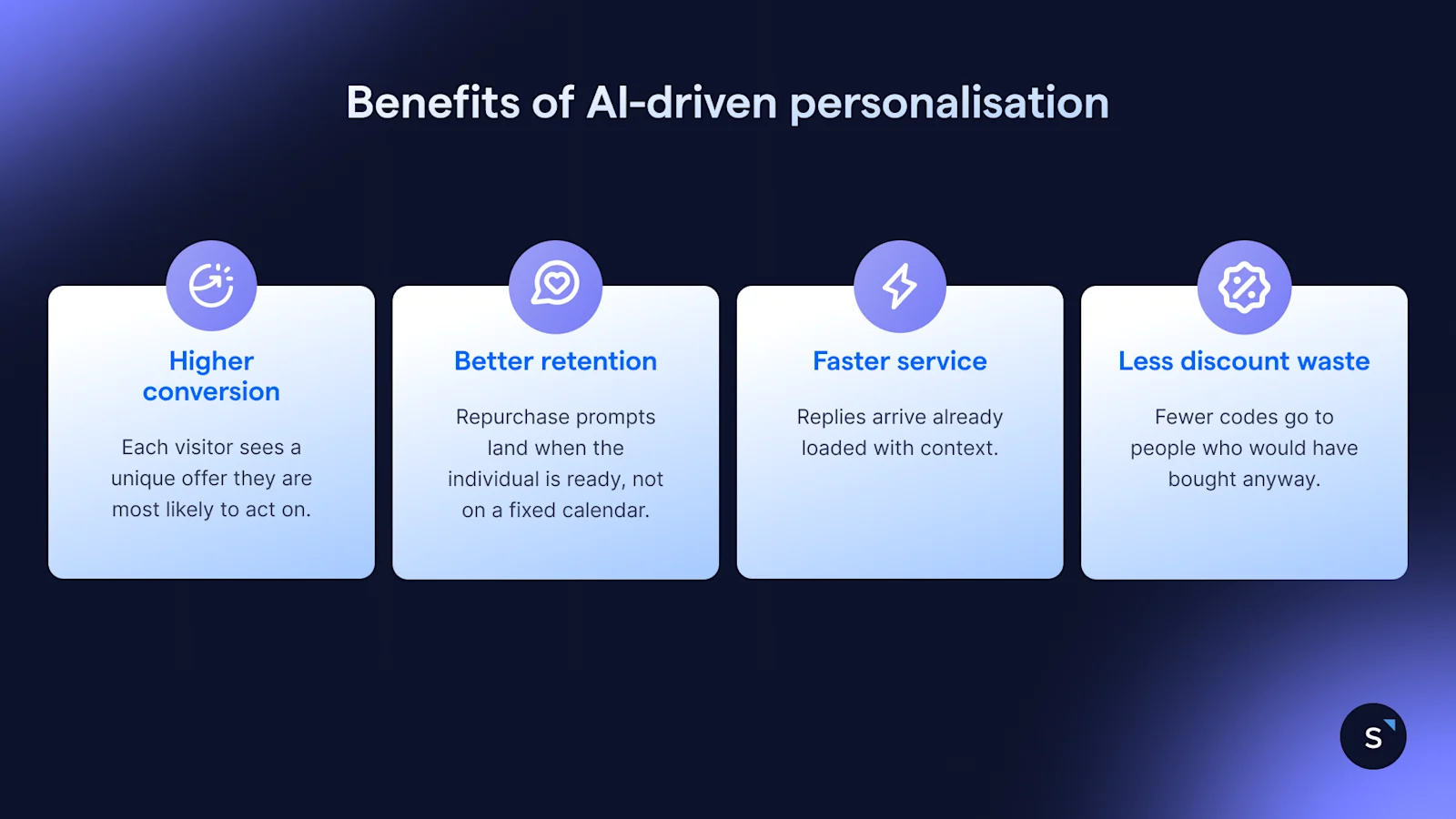
The commercial benefit is relevance at a volume humans cannot reach manually. McKinsey found that 71% of consumers expect personalised interactions and 76% get frustrated when they do not get them, which sets the floor for what customers treat as normal service.
Higher conversion on the same traffic, because each visitor sees a unique offer they are most likely to act on.
Better retention, since repurchase prompts land when the individual is ready, not on a fixed calendar.
Faster service, as replies arrive already loaded with context. Our guide on how AI improves customer experience goes deeper.
Less discount waste, because fewer codes go to people who would have bought anyway.
Privacy and data protection regarding AI personalisation in Singapore
AI personalisation runs on personal and behavioural data, so it carries real privacy exposure, and in Singapore it sits under the Personal Data Protection Act. Two separate PDPC advisory documents apply, and they are easy to confuse. Reading the wrong one for your use case is the common compliance mistake.
The Advisory Guidelines on the Use of Personal Data in AI Recommendation and Decision Systems, issued on 1 Mar 2024, cover the systems described above. They set out when the business improvement and research exceptions allow use without fresh consent, and what you must disclose: which feature needs the data, and how the processing shapes what customers see.
The Advisory Guidelines on Use of Personal Data in Generative AI, issued on 20 Jul 2026, are narrower. They cover training and fine-tuning generative models, and add an AI-specific notification where consent is the legal basis. A generic "product development" line no longer does that job.
Trust is the commercial reason to get this right, not only the legal one. In Singapore, 96% of brands said they were transparent about how AI uses customer data while 48% of consumers agreed.
This describes obligations in general terms. Have your counsel or data protection officer review your setup before launch.
How to get started, step by step
Start with one channel, one measurable outcome, and data you already trust. Teams that personalise every touchpoint at once stall on data quality rather than technology, because a model trained on duplicated records produces confidently wrong recommendations.
Pick one use case tied to a number. Cart recovery, reorder prompts, or first-reply relevance in chat.
Fix the data first. Deduplicate contacts, merge profiles across channels, confirm which fields are reliable.
Get consent and notice in order. Map the use case to the right PDPC guidance and update your notification before launch.
Set guardrails. Decide what the system may say, what it must escalate, and which data it may never touch.
Measure against a holdout. Keep a control group, and check the customer experience software you shortlist can report on it.
Singapore SMEs adopting generative AI customer engagement tools may also qualify for grant support covering part of the cost.
Real-life example: NNIO uses SleekFlow AI to recommend products to customers
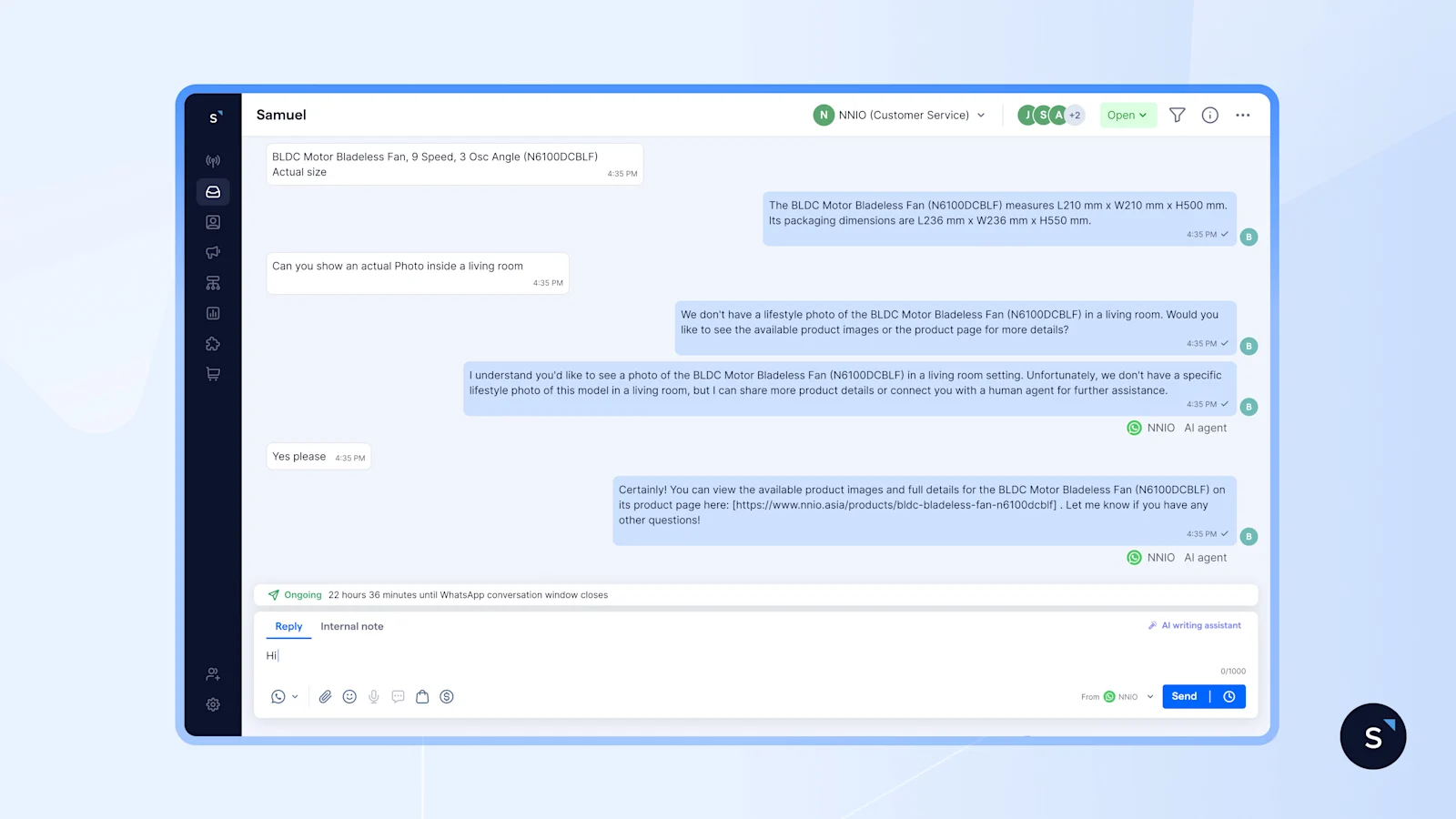
NNIO, a Singapore e-commerce brand selling home appliances, unified their messaging channels in the SleekFlow inbox, and deployed an AI agent using AgentFlow in chat.
Instead of pushing a catalogue, the AI Agent asks what actually decides the purchase: room size, budget, and preferred features. It recommends suitable products against those answers, and offers comparable alternatives when an item is unavailable. It also handles climate voucher eligibility and adapts when a shopper switches language.
Results:
40% faster response time
30% of enquiries resolved by AI agents with no human involvement
Repurchase rate up 2.6x
20% increase in completed checkouts
How SleekFlow supports AI personalisation at scale
SleekFlow is the AI suite for revenue-driving conversations. Relevance depends on one profile per customer, so the unified inbox and the data behind it do the groundwork before any model gets involved.
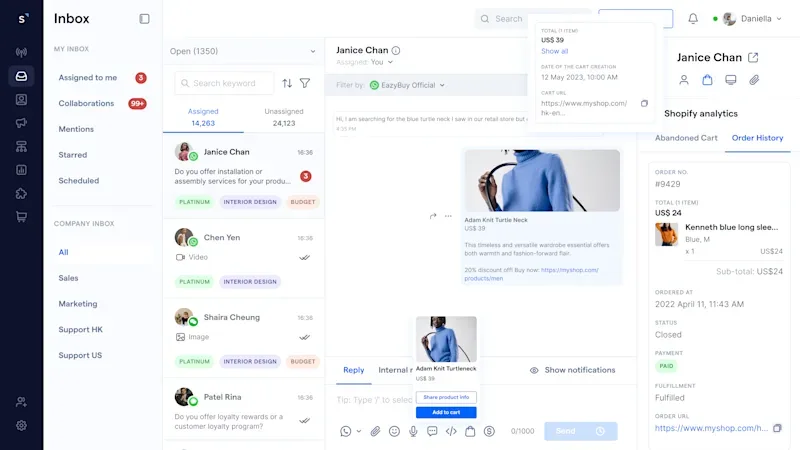
AgentFlow is SleekFlow's AI agent platform. You train an agent on your own content, connect it to systems such as Shopify, HubSpot, and Salesforce, and set guardrails for what it can say and do. In a live chat, the Inbound Agent reads intent, pulls that customer's order history, answers from your knowledge base, and hands off to a human with the thread attached.
Make your next conversation personalised
Most teams already hold the data that personalisation needs. What's missing is one profile per customer and an agent allowed to act on it. Book a demo and see how an inbound AI agent handles a live enquiry.

