Personalised customer service: what it means for the person replying


TL; DR: Quick Summary
- Personalised customer service means the agent or AI already has the customer's context, so nobody has to explain the problem twice.
- Nearly half of Singapore customers name a lack of empathy as their top service frustration, well ahead of speed.
- Personalised service is the support interaction itself, and personalised experience is the whole journey around it.
- AI now resolves a real share of enquiries directly and hands off the rest with full context attached.
- A unified inbox, not an enterprise budget, is what most small and mid-market teams need to start.
A customer messages about a late order. The agent sees a name and a single message, nothing else, and sends back a reply that could have gone to anyone. The order gets sorted, but the customer still walks away feeling like a ticket number, not someone who has bought from you three times.
That gap, between a reply that closes the ticket and one that recognises the person, is what personalised customer service actually measures. Below is what that looks like in practice, and how support teams in Singapore are closing it.
What is personalised customer service?
Personalised customer service is support tailored to the individual customer, built on their preferences, history, and past interactions rather than a one-size-fits-all reply. The agent or AI knows the customer's context before responding, so help is relevant and quick, and the customer never repeats themselves, whatever channel they use.
Two things get mistaken for it. A first name merged into a template is formatting, not personalisation. A reply that resolves the issue but starts from zero context is efficient, not personal. Real personalised service does both: it moves fast, and it remembers.
Why personalised customer service matters in Singapore
Personalised service is the difference between a customer who tolerates your business and one who trusts it, and the gap shows up in how empathetic a reply feels, not how quickly it arrives. ServiceNow's 2026 study of Singapore customers found 48% cite a lack of empathy as their top service frustration, while only 28% of executives think that gap causes serious problems.
The same study found service reps use four or more separate systems on average and spend only 35% of their time actually addressing the customer's issue. That is not a training problem. It is a data problem, and it is the one personalised service is built to solve.
Personalised customer service versus personalised customer experience
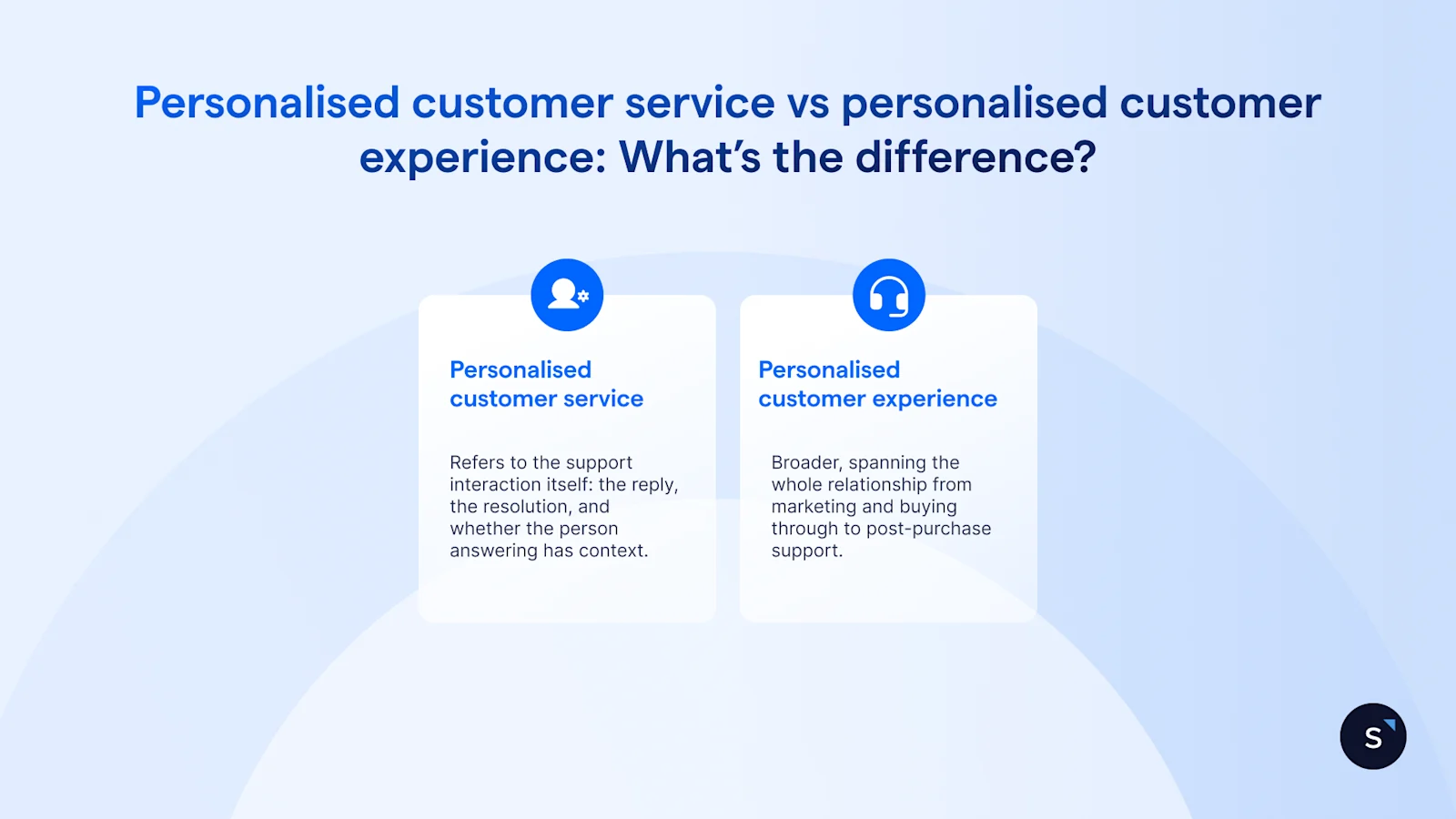
Personalised service, in this narrower sense, is the support interaction itself: the reply, the resolution, and whether the person answering already knows what happened before. Personalised customer experience is broader, spanning the whole relationship from marketing and buying through to post-purchase support. Service is one part of the wider experience.
Fix service first if you can only fix one. A polished campaign followed by a support reply that starts from nothing undoes the goodwill in one message. For the fuller picture across the whole relationship, see our companion piece on personalised customer experience.
How AI is changing personalised service at scale
AI reads a customer's history and current message, surfaces the relevant context for a human agent, and can answer simple queries instantly in a way that fits that customer. It routes conversations by topic or urgency and escalates anything complex to a person with a summary attached, so service stays personal even as volume climbs past what a human team could read one message at a time.
The resolution gains are real once the underlying data is unified. Wiley, the publisher, saw case resolution improve by more than 40% after moving from a scripted bot to an agentic AI system, because the AI could act on customer history rather than follow a script. AI personalises well only when it has something real to personalise from.
Ways to deliver personalised customer service
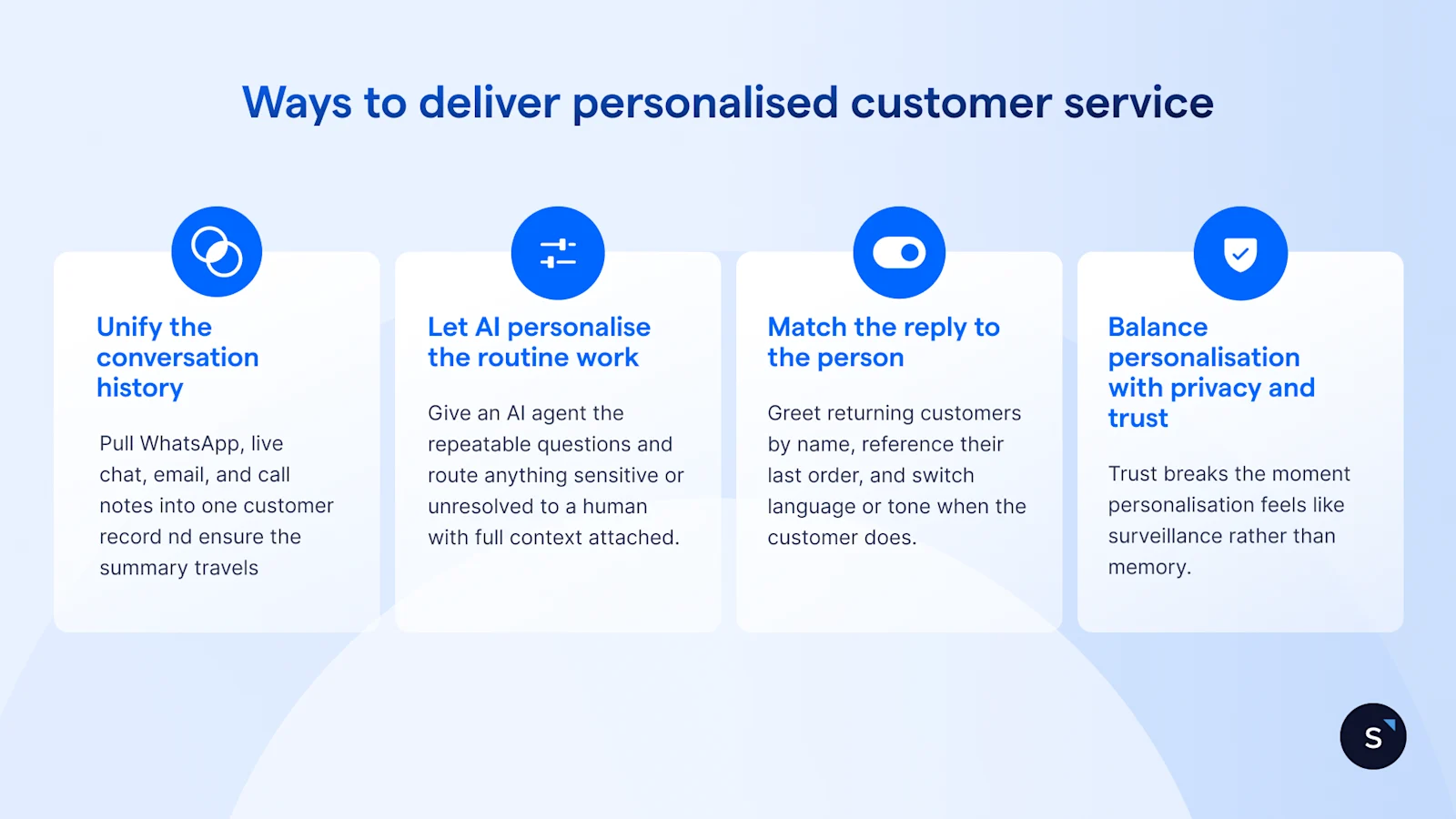
Unify the conversation history, and carry it through every handover
Pull WhatsApp, live chat, email, and call notes into one customer record, so whoever answers next sees what already happened, and make sure that same summary travels when a conversation moves from an AI agent to a person or between agents. A unified inbox is the fastest way most teams get here, and handovers are where personalisation is most often lost.
Let AI personalise the routine work, and escalate the rest cleanly
Give an AI agent the repeatable questions: order status, warranty terms, and product recommendations based on what someone actually bought, and route anything sensitive or unresolved to a human with full context attached. An agent that resolves 60% of enquiries and hands over cleanly beats one that resolves 80% and leaves the rest stuck.
Match the reply to the person, not the template
Greet returning customers by name, reference their last order, and switch language or tone when the customer does. Small moves, done consistently, read as attentive. A name merged into a generic reply reads as exactly what it is.
Balancing personalisation with privacy and trust
Singapore's PDPA lets businesses use customer data to personalise service without fresh consent in some circumstances, but it requires clear notice: what data you use, why, and how it shapes the service someone gets. Trust breaks the moment personalisation feels like surveillance rather than memory.
The PDPC's advisory guidelines on personal data in AI recommendation and decision systems set out what businesses must disclose, and allow layered notice through privacy policies and in-product messaging.
How SleekFlow helps you deliver personalised customer service
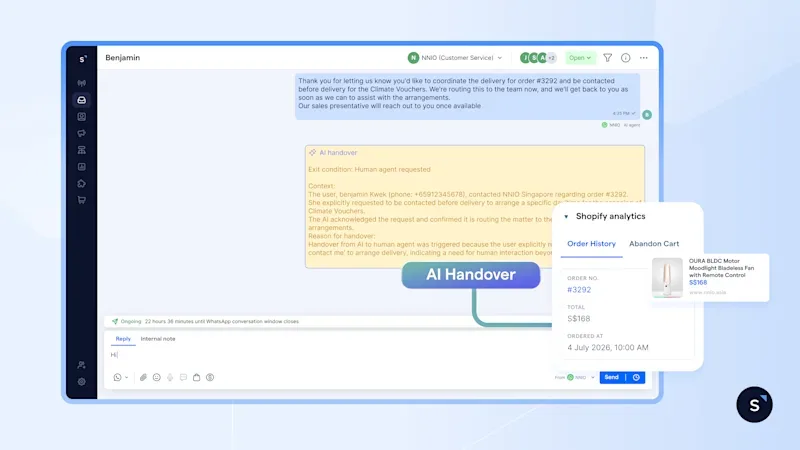
SleekFlow is the AI suite for revenue-driving conversations, and for customer service, the job is unglamorous: get the right context to whoever, or whatever, replies next.
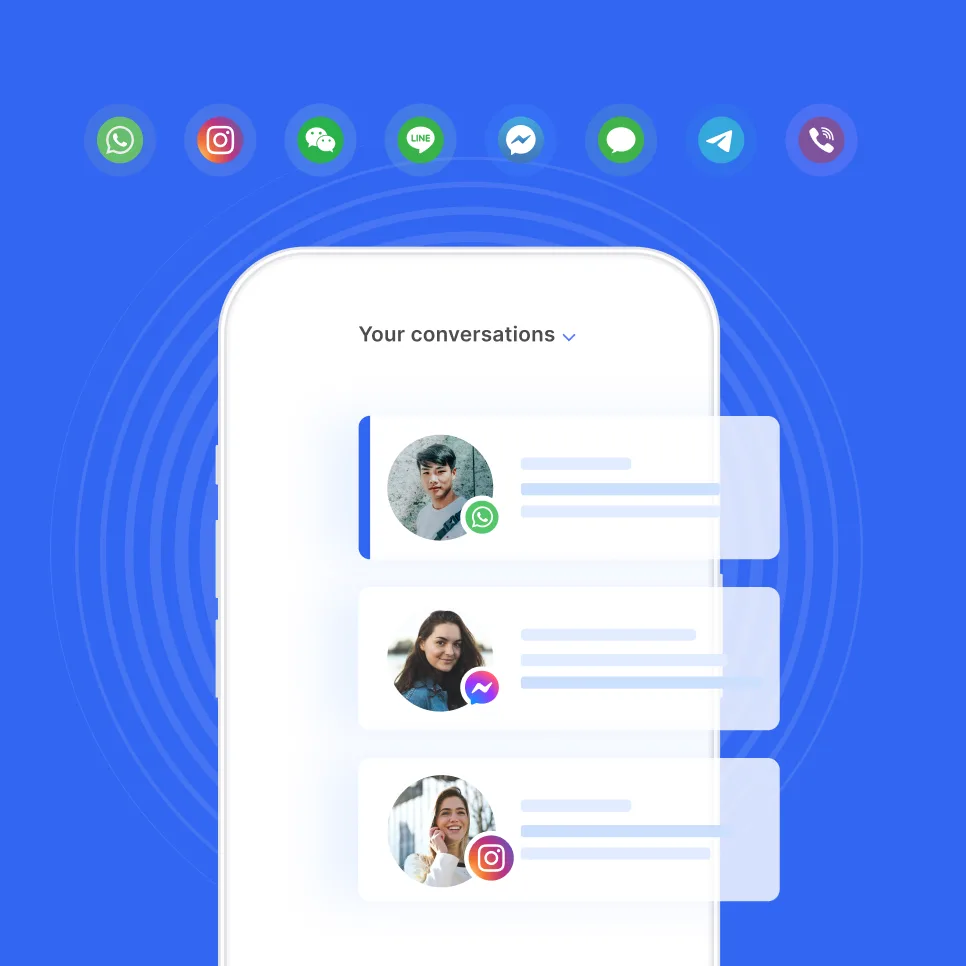
Inbox brings WhatsApp, Instagram, live chat, and email into one thread per customer, so an agent never opens a conversation cold.
AgentFlow, SleekFlow's AI agent platform, answers routine enquiries using that same history, switches language mid-conversation when the customer does, and hands off anything it cannot resolve with a full summary attached.
NNIO, a Singapore e-commerce brand selling home appliances, had four separate teams answering customer questions with no shared view of who was asking. Its AI agent now switches from English to Chinese mid-conversation, recommends products based on purchase history, and sends warranty information automatically, while a WhatsApp warranty flow pulls in-store buyers into the same record.
Results:
Response time dropped 40%
AI agents now resolve 30% of enquiries without a human
Customer retention rose 260%
Personalised service is not a bigger team or a longer script. It is whoever picks up the conversation next already knowing what happened before.
Make your next conversation personalised
Most teams already hold the data that personalisation needs. What's missing is one profile per customer and an agent allowed to act on it. Book a demo and see how an inbound AI agent handles a live enquiry.


