The complete guide to omnichannel marketing


TL; DR: Quick Summary
- Customers now move across multiple channels before they buy, and they expect every interaction to feel consistent and connected.
- Omnichannel marketing unifies channels, teams, and customer data into one continuous journey, while multichannel focuses on channel presence and cross-channel connects selected touchpoints.
- Research from Salesforce and McKinsey shows that connected customer journeys can lead to higher spend, more frequent shopping, and stronger business growth.
- Real-world examples such as Loft Home, BateriHub and How2design4u show how unified messaging, automation, and better channel coordination improve conversion and customer experience.
- Success depends on unified customer data, shared inboxes, AI-driven automation, and attribution that helps teams measure and optimise what drives revenue.
Every year, more customers switch between channels before buying. They discover a product on Instagram, research it on your website, ask a question on WhatsApp, and pick it up in-store. According to McKinsey, 60–70% of consumers now research and shop across both online and offline channels simultaneously, and they expect every single touchpoint to feel connected.
For businesses, this shift creates both a challenge and an enormous opportunity. The challenge: maintaining consistency and continuity across a growing number of channels. The opportunity: brands that successfully connect those channels see dramatically higher retention, average order value, and customer lifetime value.
This guide breaks down everything you need to know about omnichannel marketing: what it is, how it differs from multichannel, what the research says, how real companies across six industries have applied it, and how to build your own strategy from scratch.
What is omnichannel marketing?
Omnichannel marketing is the integration of all marketing channels, online and offline, to deliver a consistent, personalised, and seamlessly connected brand experience at every touchpoint across the customer's buying journey.
The word 'omni' comes from Latin, meaning 'all' or 'every'. In practice, this means whether a customer contacts you via WhatsApp, clicks an Instagram ad, visits your website, or walks into a physical store, the experience feels like one continuous conversation, not a series of disconnected interactions.
To deliver a true omnichannel experience, businesses typically need to:
Maintain a unified customer data profile accessible across all channels in real time
Ensure brand messaging, tone, and promotions are consistent across every touchpoint
Allow conversations to continue across channels without the customer repeating themselves
Use behavioural data from each interaction to personalise the next one
Break down internal silos so that marketing, sales, and customer service share a single view of the customer
Key channels in a modern omnichannel strategy
A comprehensive omnichannel strategy spans:
Messaging apps: WhatsApp, Instagram DM, Facebook Messenger, Telegram, LINE, WeChat
Email & SMS: Broadcast campaigns, re-engagement flows, and transactional notifications
Social media: Instagram, Facebook, TikTok, for discovery, retargeting, and engagement
Website & e-commerce: Your owned digital storefront and product catalogue
Mobile app: Loyalty programmes, mobile ordering, and personalised push notifications
Physical stores: Integrated POS, QR codes, and in-store digital touchpoints
Customer service: Live chat, phone, and helpdesk, all sharing the same customer history
Omnichannel vs. multichannel vs. cross-channel marketing: what's the difference?
These three terms are often used interchangeably, but they describe very different ways of managing customer journeys. Understanding the difference matters because many businesses think they are running an omnichannel strategy when they are actually operating across multiple disconnected channels.
Multichannel marketing
Multichannel marketing means a business is present on more than one channel, such as email, social media, paid ads, live chat, WhatsApp, or physical stores. The goal is reach: meet customers wherever they are.
The limitation is that each channel often operates independently. Different teams may manage different platforms, customer data may be stored in separate systems, and conversations do not automatically carry over from one touchpoint to the next. A customer might click an Instagram ad, sign up by email, and later message your team on WhatsApp, but each interaction is treated as separate.
Cross-channel marketing
Cross-channel marketing goes one step further. Channels are not fully unified, but they do work together in specific journeys or campaigns.
For example, a customer might click an email, land on a product page, then receive a retargeting ad or a follow-up message based on that action. There is some coordination between channels, but it is usually limited to defined workflows rather than the entire customer experience.
In other words, cross-channel marketing connects selected channels for selected use cases. It improves campaign orchestration, but it does not always create a single, shared view of the customer across the business.
Omnichannel marketing
Omnichannel marketing is the most integrated approach. All customer-facing channels work together using shared data, shared context, and consistent messaging so the experience feels like one continuous conversation.
A customer can discover a product on Instagram, ask a question on WhatsApp, browse the website, visit a store, and receive a follow-up message afterwards without having to repeat themselves. Marketing, sales, and support all operate from the same customer context, making personalisation and continuity possible across the full journey.
A simple way to think about it
Multichannel is about presence. Cross-channel is about coordination. Omnichannel is about continuity.
That distinction is important because a business can be active on many channels without delivering a connected customer experience. True omnichannel marketing only happens when channels, teams, and customer data work together in real time.
Which approach should businesses aim for?
Multichannel is often the starting point. Cross-channel is the next stage, where teams begin connecting touchpoints for better campaign performance. Omnichannel is the long-term goal for businesses that want to improve customer experience, increase conversion rates, and build stronger lifetime value.
For most growing businesses, the practical path is to start by connecting the channels customers use most, then unify customer data, automate handoffs, and build towards a fully omnichannel experience.
Why omnichannel marketing matters: the data
The business case for omnichannel marketing is well documented across industries. Salesforce’s Connected Customer research found that 69% of consumers expect consistent interactions across departments, and nearly 60% prefer fewer touchpoints to get information or complete a task. The pattern is clear: when brands connect channels seamlessly, they reduce friction for customers and create stronger conditions for growth. In B2B, McKinsey’s global research found that 72% of companies selling through seven or more channels gained market share.
What customers actually want from an omnichannel experience
Understanding the 'why' behind omnichannel strategy requires understanding how modern buying behaviour has changed. Consider a typical customer journey for a skincare purchase today:
Discovers a product through an Instagram ad
Researches reviews on Google and reads a blog post
Sends a WhatsApp message to ask about ingredients
Visits the physical store to see the product in person
Places an order online for home delivery
At every one of those five touchpoints, the customer expects the brand to know who they are and what they've already discussed. According to Salesforce, 76% of customers expect companies to understand their needs and expectations, yet 54% say it generally feels like sales, service, and marketing don't share information.
The brands that make every channel feel like a natural extension of the conversation are the ones that win loyalty, higher spend, and word-of-mouth referrals.
Omnichannel marketing in action: real business results
Below are six real businesses, across six industries, that implemented omnichannel marketing and measured the results.
Retail & eCommerce: Loft Home
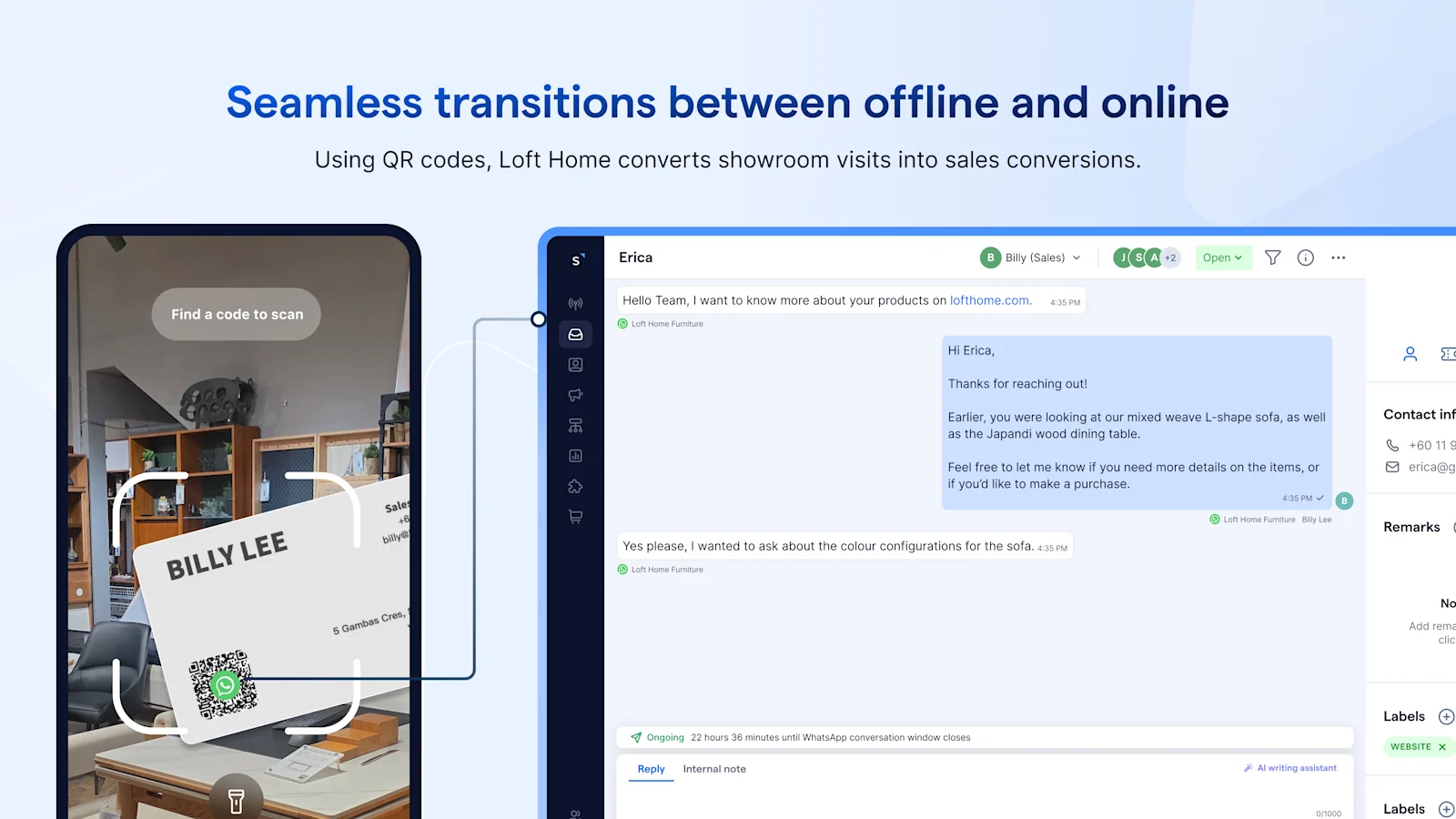
Loft Home shows how omnichannel marketing can connect showroom visits with digital follow-up in a way that feels natural for both customers and sales teams. Furniture purchases are rarely made on impulse, so Loft Home gives each salesperson a unique WhatsApp QR code printed on their name card. When a customer scans the code after visiting the showroom, the conversation is routed back to the same salesperson they met in person. This helps Loft Home turn offline interest into ongoing one-to-one sales conversations, while also giving customers an easy way to ask post-purchase questions after they buy.
Loft Home also uses different channels for different stages of the journey. For important updates such as order confirmations and shipping notifications, the brand sends both email and WhatsApp messages, combining the formality of email with the speed and convenience of chat. For marketing, email supports broader newsletter engagement, while WhatsApp is used for bottom-funnel follow-up. By segmenting high-intent leads, such as customers who recently visited the showroom but have not yet purchased, Loft Home can send targeted WhatsApp broadcasts that help re-engage prospects and move them closer to conversion.
Automotive: BateriHub
BateriHub operates 130 branches for car battery services across West Malaysia. Before implementing omnichannel, they had no visibility into which marketing campaigns were driving leads. Customer conversations were scattered across individual team members' personal WhatsApp accounts. And their team manually cross-referenced over 220 battery models for every customer enquiry, a time-consuming, error-prone process.
SleekFlow's omnichannel platform unified all incoming messages from WhatsApp, social media, and the website into a single inbox. An AI chatbot automatically handled battery compatibility queries, drastically reducing manual lookup time. Centralised analytics connected incoming conversations directly to specific ad campaigns, giving the marketing team clear attribution data to optimise spend. Lead scoring filtered out spam before it reached the sales team. The results:
17× faster response speed
<1% spam leads
22% increase in conversions in 3 months
Travel: Intriq Journey
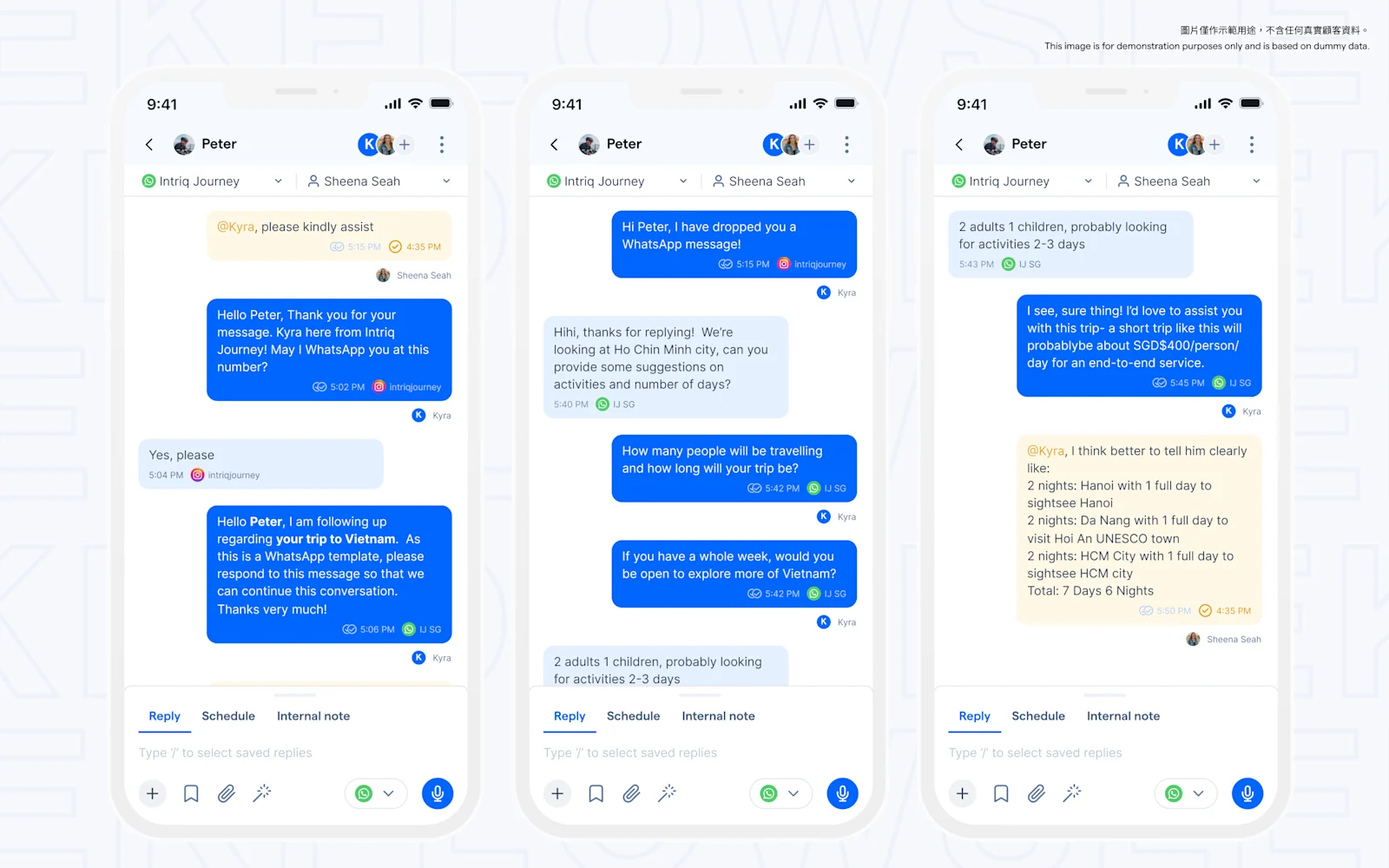
Intriq Journey designs personalised luxury tours for high-profile travellers from Hong Kong and Singapore. Their clients expect instant, seamless, and highly personalised responses; the standard email-and-phone approach was too slow and fragmented. The WhatsApp Business App's single-login limitation prevented the team from handling simultaneous conversations across two markets.
SleekFlow enabled Intriq Journey to manage multiple WhatsApp Business API accounts across Singapore and Hong Kong on a single platform, alongside Facebook and Instagram. Broadcast campaigns sent personalised travel inspirations to segmented customer lists, achieving 75% read rates that email campaigns could not match. The unified inbox gave every team member a complete view of the customer's travel history and preferences, enabling truly personalised responses at scale.
Professional Services: How2design4u
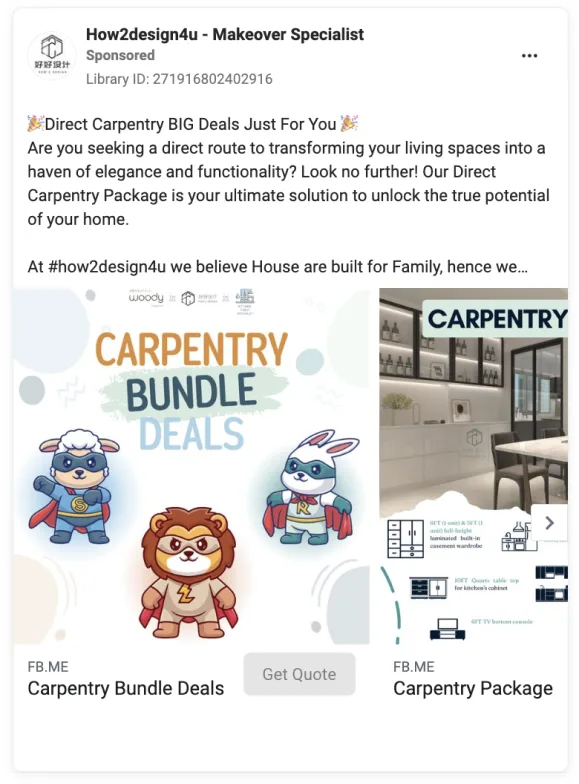
How2design4u is a Singapore-based interior design and renovation company. With limited manpower and enquiries arriving across WhatsApp, Instagram, Facebook, and email at all hours, including midnight, the team couldn't respond fast enough. Cold leads went to competitors who replied first. Management had no visibility into conversation quality or conversion rates, and customer data was manually tracked across Excel sheets.
SleekFlow automatically responds to every new lead across all channels within seconds, regardless of the time of day. A unified CRM replaced the Excel sheet, giving management real-time visibility into the pipeline. Automated follow-up sequences nurtured leads who didn't convert immediately, keeping H2D top of mind. The 91% automated reply rate meant no enquiry went unanswered, and the team could focus their human time on qualified, high-intent conversations. The results:
$450,000 in revenue attributed to the omnichannel strategy
2× more leads generated
91% reply rate on automated messages
Benefits of omnichannel marketing for businesses
Increased customer engagement
When a customer receives messaging that reflects their past behaviour, whether it's a WhatsApp follow-up to a product they viewed online, or a retargeting ad based on an in-store visit, they are significantly more likely to engage. The personalisation that omnichannel enables drives higher open rates, click rates, and response rates compared to generic broadcast marketing.
Higher customer retention and loyalty
Aberdeen Group's research shows that companies with strong omnichannel engagement retain 89% of their customers on average. The reason is straightforward: customers who feel understood and served consistently across channels see less reason to switch to a competitor. This is reinforced by our case studies, Ms. Chu built 10,000 loyal members and EGL Tours grew their WhatsApp contact base by 100,000 in six months, in both cases creating retention assets that compound over time.
Increased sales and revenue
Omnichannel customers are more valuable. Harvard Business Review's study of 46,000 shoppers found they spend 10% more per online order and 4% more per in-store visit. Epsilon research found that 80% of consumers are more likely to purchase when brands offer personalised experiences, and personalisation is only possible when channel data is unified. How2design4u's $450K in attributed revenue from an omnichannel sales strategy is a direct example of this in practice.
Better customer insights
A siloed marketing operation produces siloed data: you know what someone bought on your website but not how they heard about you, what they asked on WhatsApp, or what they browsed in-store. An omnichannel approach unifies that data, giving you a 360° view of every customer. BateriHub went from having no clear attribution data to being able to trace every conversion back to a specific ad campaign, enabling confident decisions about where to invest marketing budget.
Lower cost-per-acquisition over time
Omnichannel marketing improves both retention (reducing the need to replace churning customers) and conversion (reducing the cost of moving a prospect through the funnel). When existing customers are more likely to buy again, as Ms. Chu's 50% sales increase shows, the ratio of revenue from existing vs new customers shifts in your favour. Customer retention is consistently cheaper than acquisition across every industry studied.
How to build an omnichannel marketing strategy: 5 steps
Implementing omnichannel marketing is a process, not a one-time project. Here is a practical five-step framework based on how successful businesses approach it.
Step 1: Map your customer journey across all touchpoints
Before you can connect channels, you need to understand how customers actually move between them. Map every touchpoint from first discovery to post-purchase, and identify the gaps where continuity breaks down. Common gaps: a customer who contacted you on Instagram is transferred to email with no context; in-store customers can't access their online loyalty points; support agents have no visibility into purchase history.
Conduct customer interviews to understand their real journey, not your assumed one
Audit every current channel and how data is stored within it
Identify the three most significant breakpoints, where customer experience becomes inconsistent
Step 2: Unify your customer data
The foundation of any omnichannel strategy is a single customer profile. Without it, you are just multichannel. Your unified profile should capture: purchase history (online and offline), communication history across all channels, preferences and product affinities, and loyalty programme status.
Choose a CRM or CDP (Customer Data Platform) that integrates with all your channels
Map data fields between systems to ensure consistent records, particularly name, contact number, and email
Define how conflicts are resolved when the same customer appears in multiple systems
Step 3: Integrate your channels, starting with messaging
Not every business needs to integrate all channels simultaneously. Prioritise by where your customers actually are. For most B2C businesses in Southeast Asia, the Middle East, and the broader Asia-Pacific region, WhatsApp is the highest-priority channel, followed by Instagram DM and Facebook Messenger.
Connect messaging channels to a shared team inbox so any agent can pick up any conversation with full context
Integrate your e-commerce platform (Shopify, VTEX, etc.) so agents can see purchase history during conversations
Set up automation for the most common entry-point queries, first contact, FAQs, order status, so response is instant 24/7
Step 4: Personalise at scale with automation and AI
Once channels are connected and data is unified, automation and AI make personalisation scalable. Without automation, personalisation only works at low volume, with it, it works across hundreds of thousands of customer interactions.
Use behaviour-triggered automations: send a WhatsApp follow-up when a customer abandons a cart, views a product 3 times, or hasn't purchased in 90 days
Deploy AI agents for 24/7 first-response across messaging channels, AI can qualify leads, answer product questions, and book appointments without human intervention
Segment your customer base for broadcast campaigns, send different messages to new customers, recent purchasers, and lapsed customers
Step 5: Measure, optimise, and expand
Omnichannel strategy is not a set-and-forget exercise. Measure the metrics that matter (see Section 9), identify the weakest points in your customer journey, and continuously test improvements.
Review attribution data monthly to understand which channels and campaigns drive the highest-value customers
A/B test message content, timing, and channel mix for broadcast campaigns
Expand to new channels only when existing channels are performing consistently
Use customer satisfaction scores and response time data to identify service gaps
Omnichannel attribution: measuring what works
One of the most significant challenges in omnichannel marketing is attribution: understanding which channels and touchpoints actually drove a conversion. In a multichannel environment, a customer may have seen an Instagram ad, clicked a Google retargeting banner, sent a WhatsApp enquiry, and then purchased in-store. Which channel gets credit?
For most growing businesses, the practical recommendation is to start with a multi-touch approach that records every touchpoint and regularly review which channels appear most frequently across high-value customer journeys. BateriHub went from no attribution visibility to being able to trace every WhatsApp conversion back to a specific ad, transforming how they allocated their marketing budget.
Omnichannel marketing KPIs: what to measure
Measuring the success of your omnichannel strategy requires tracking metrics across three areas: customer experience, marketing performance, and revenue.
Customer experience KPIs
Customer Satisfaction Score (CSAT): Post-interaction rating across all service channels. Aim for 4+/5 consistently.
First Response Time (FRT): Time from a customer message to first reply. Industry best practice: under 5 minutes for messaging channels.
Customer Effort Score (CES): How easy customers find it to resolve issues or complete purchases. Lower effort = higher loyalty.
Net Promoter Score (NPS): Likelihood to recommend. Tracks loyalty and advocacy over time.
Marketing performance KPIs
Channel attribution rate: % of conversions where the originating channel is known and recorded.
Broadcast open and read rates: WhatsApp broadcasts target 70%+ read rate (vs ~22% email). Intriq Journey achieved 75%.
Lead-to-conversion rate by channel: Understand which channels produce the highest-quality leads.
Cost per acquisition (CPA) by channel: Compare to understand where marketing budget delivers best ROI.
Revenue KPIs
Customer Lifetime Value (CLV): Total revenue from a customer over the relationship. Omnichannel strategies should increase this over time.
Average Order Value (AOV) by channel: Ms. Chu doubled AOV after implementing omnichannel, track this across your channels.
Revenue attribution by channel: EGL Tours attributed 70% of sales to WhatsApp after implementation. Know your numbers.
Repeat purchase rate: % of customers who buy more than once. The clearest signal of omnichannel loyalty effectiveness.
Integrating AI into your omnichannel marketing strategy
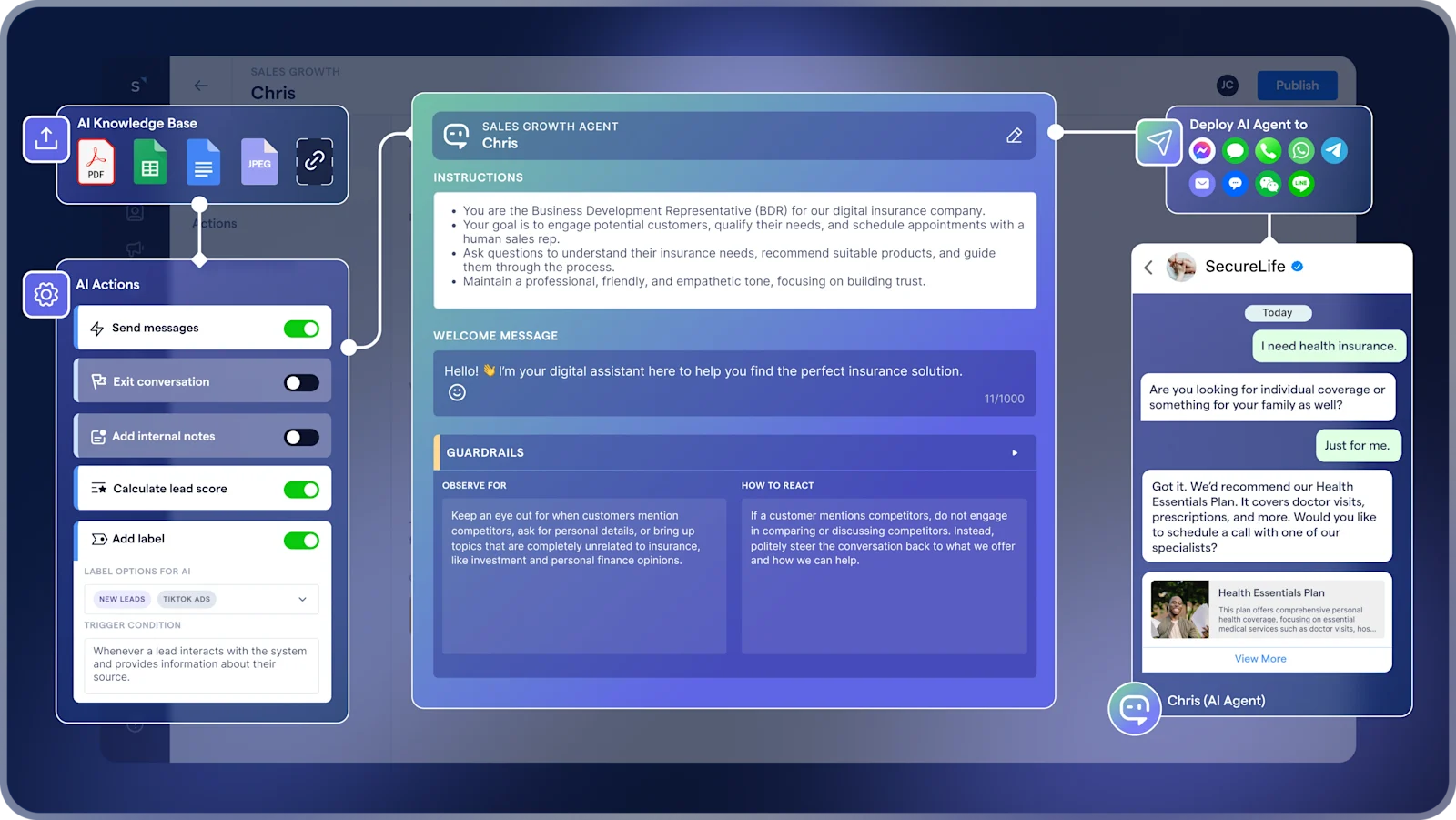
Artificial intelligence is rapidly changing what omnichannel marketing can accomplish. Three years ago, personalisation at scale required large teams. Today, AI agents can handle thousands of simultaneous conversations, qualify leads, recommend products, and book appointments, all while maintaining a brand-consistent tone across every channel.
What AI enables in omnichannel marketing
24/7 instant first response: How2design4u eliminated the problem of leads going cold overnight by deploying automated responses that engaged new enquiries within seconds, regardless of the hour.
Intelligent routing: AI can analyse the intent of an incoming message and route it to the right team member, or resolve it autonomously if it matches a known query pattern. BateriHub used this to reduce spam leads to under 1%.
Personalised product recommendations: Based on purchase history and conversation context, AI can suggest the right product at the right moment, across WhatsApp, your website, or in-app.
Automated follow-up sequences: Triggered by behaviour (cart abandonment, viewed but not purchased, lapsed customer), AI sequences re-engage prospects without manual effort.
Conversation analysis and coaching: AI can review conversation transcripts to identify patterns in high-converting interactions and flag quality issues for managers.
SleekFlow's AgentFlow enables businesses to deploy AI agents across WhatsApp, Instagram, Facebook Messenger, and other channels. AgentFlow agents can qualify leads, answer product questions, process orders, book appointments, and escalate complex issues to human agents, all within a unified inbox where every conversation is recorded and attributed.
How SleekFlow powers omnichannel marketing
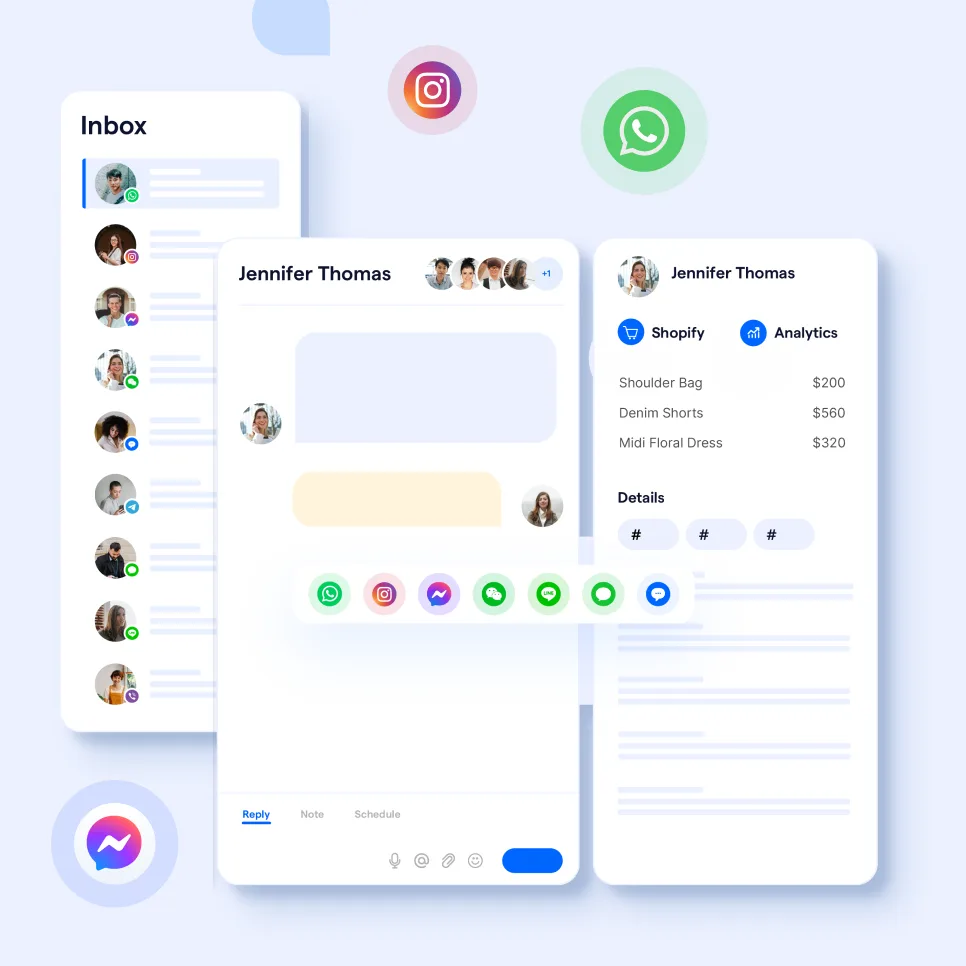
SleekFlow is an omnichannel business messaging platform used by over 2,000 enterprises across 70 countries. It is built specifically to help businesses connect their messaging channels, unify customer data, automate conversations at scale, and attribute revenue to specific campaigns and interactions. Here are some of our key capabilities that support an omnichannel marketing strategy:
Shared team inbox: All conversations across WhatsApp, Instagram, Facebook Messenger, Telegram, LINE, WeChat, and more, in one place, with full customer history visible to every agent.
Social CRM: A unified customer profile built from every interaction across all channels, including purchase history synced from Shopify and other e-commerce platforms.
Automation Flow Builder: Drag-and-drop workflow automation for lead qualification, follow-up sequences, appointment booking, and order updates, triggered by customer behaviour across channels.
Broadcast Campaigns: Personalised bulk messaging across WhatsApp and other channels, with segmentation based on CRM data and full attribution reporting.
AgentFlow AI: AI agents that handle first-response, product recommendations, and lead qualification autonomously, with seamless handoff to human agents when needed.
Analytics: Campaign performance, agent response times, conversion rates by channel, and broadcast read rates, all in one dashboard.
Frequently Asked Questions
How should businesses handle omnichannel marketing when customer data conflicts across systems?
Can omnichannel marketing still work when customers want to stay anonymous until late in the buying journey?
What happens when different channels create different expectations for speed and tone?
How can businesses run omnichannel marketing if they sell through marketplaces and do not own the full customer relationship?
How do you prevent omnichannel marketing from becoming over-messaging across too many channels?
Recommended for you


