customer service automation for your business in the UAE


TL;DR: Quick Summary
- Customer service automation uses AI, chatbots, and workflow tools to handle repetitive tasks, streamline processes, and enhance customer interactions.
- Automation improves customer satisfaction, loyalty, and engagement by delivering quick, consistent, and 24/7 support.
- Integrating automation with CRMs and omnichannel platforms creates a seamless, unified customer experience across touchpoints.
- Automated systems save time and costs while enabling proactive engagement through messages, notifications, and personalized recommendations.
- UAE businesses like Emirates Airlines and TKD Lingerie leverage automation for WhatsApp support, marketing campaigns, and virtual services, improving efficiency and customer satisfaction.
- Platforms like SleekFlow offer omnichannel integration, AI chatbots, centralized data, and analytics to optimize customer support and drive business growth.
Customer service automation in the UAE usually works best when businesses automate high-volume, repetitive support tasks across WhatsApp, Instagram, website chat, and CRM workflows, while keeping human agents for complex, sensitive, or high-value conversations. UAE customers increasingly expect personalized, seamless omnichannel experiences, which is why automation works best when it is tied to messaging, CRM context, and fast escalation rules.
This article explores the benefits, strategies, and successful examples of customer service automation for businesses in the UAE.
What is customer service automation

Customer service automation refers to the utilization of advanced tools and technologies to streamline and optimize customer interactions without manual intervention.
It involves automating repetitive tasks to enhance efficiency and provide a seamless customer experience.
By leveraging automated customer engagement businesses in the UAE can effectively manage customer inquiries, resolve issues promptly, and focus on delivering personalized service.
Below are some examples of tools and technologies used in customer support automation:
Automated customer support chat:: An AI chatbot for customer service can handle common customer queries instantly, guide users through FAQs, and even perform tasks like booking appointments or processing transactions, reducing the workload on customer service agents.
CRM integration: Implementing an automated customer relationship management (CRM) system enables businesses to store customer data, track interactions, and automate tasks, resulting in improved customer service efficiency.
Self-service portals: These online portals provide customers with access to a knowledge base, FAQs, and troubleshooting guides, empowering them to find solutions independently.
Workflow automation tools: These tools automate repetitive tasks and processes, reducing manual effort and streamlining support workflows for increased efficiency.
Data analytics and reporting platforms: These tools collect and analyze customer support data, providing valuable insights into performance metrics, customer satisfaction, and trends for data-driven decision-making.
Benefits of using customer support automation in the UAE

1) Enhanced customer satisfaction and retention
By implementing automated customer engagement tools, businesses can provide prompt and consistent support to their customers. Quick issue resolution and efficient handling of inquiries contribute to a positive customer experience, leading to increased satisfaction and a higher likelihood of customer loyalty and retention.
2) Integration with other systems
Customer service automation can integrate with other business systems, such as CRM platforms or e-commerce platforms to create an omnichannel customer service. This integration facilitates the seamless flow of customer information, order details, and support history, enabling a holistic view of the customer journey. It ensures consistency and coherence across different touchpoints, contributing to a unified customer experience.
3) Cost-effectiveness and time-saving
By automating repetitive tasks and processes, businesses can reduce the need for manual intervention, which in turn saves valuable time and resources. Customer support automation allows businesses to handle a larger volume of inquiries and support requests without a proportional increase in operational costs, making it a cost-effective solution for customer support.
4) 24/7 support and quick response times
With customer support automation in place, businesses can provide round-the-clock availability, delivering support even outside of regular business hours. This availability enhances the customer experience by minimizing wait times and ensuring quick response times, which builds trust and strengthens the relationship between businesses and their customers.
5) Proactive customer engagement
65% of consumers in the UAE expect businesses to provide them with proactive communication. Hence, businesses that incorporate automated customer service are able to proactively engage with customers through features like automated WhatsApp messages, proactive notifications, and personalized recommendations. These proactive interactions help businesses stay connected with customers, address their needs in a timely manner, and foster a proactive and customer-centric approach.
6) Data-driven insights
Customer service automation generates valuable data and insights that businesses can leverage to make informed decisions. Analytics and reporting tools provide visibility into customer interactions, trends, and performance metrics. This data-driven approach helps businesses identify areas for improvement, optimize support strategies, and enhance the overall customer experience.
What makes customer service automation different in the UAE
Customer service automation in the UAE should not be treated as a generic cost-saving project. UAE buyers increasingly expect personalized service, value for money, and seamless omnichannel processes, and KPMG’s UAE customer experience research says brands are turning to AI and data-driven models to meet those expectations. In its newer UAE report, KPMG also describes leading brands as focusing on hyper-personalized, predictive, and seamless experiences, with the best-performing organizations reducing friction across channels rather than treating each touchpoint separately.
That makes the UAE market especially important for bilingual and multilingual support. Arabic is the official language of the UAE, and the official UAE government and Ministry of Foreign Affairs both note that English is also widely used in business and everyday life. In practice, that means automation should not only be fast; it should also be able to handle customers comfortably in Arabic and English, and often support broader multilingual handoff depending on the audience a business serves.
Another major difference is the role of WhatsApp and Instagram as service channels, not just marketing channels. WhatsApp Business officially positions its platform as a way for businesses to drive sales and support outcomes through two-way conversations, including order confirmations, shipment updates, appointment availability, and reminders. Meta also positions Instagram business messaging as a way for brands to connect with customers through ads, their Instagram account, or their website. In the UAE, where social and messaging use is especially high, that makes these channels central to how support is delivered, not just how leads are generated.
This matters even more in high-value, service-led sectors. KPMG’s 2025 UAE report says Travel and Hospitality is the top-performing sector in Customer Experience Excellence, driven by expectations around personalization, seamless booking, and loyalty. The same report says UAE retail is being reshaped by rising customer expectations, digital efficiency, and personalized service across channels. That same pressure naturally extends to other service-heavy categories such as clinics, automotive, and education, where customers often want quick answers, booking help, reassurance, and a smooth handoff to a human when the issue becomes more complex.
A strong UAE customer service automation strategy, then, is not just about adding a chatbot. It is about delivering personalized, bilingual, messaging-first support across WhatsApp, Instagram, live chat, and CRM-connected workflows, while keeping human agents ready for the moments where empathy, judgment, and reassurance matter most. KPMG’s UAE research makes that the clearest local takeaway: automation works best here when it improves speed and convenience without losing the human quality of the experience.
How to start using customer service automation?
Starting with customer service automation involves several key steps that help businesses implement and maximize the value of automation in their customer service operations. Here’s how you can get started:
1. Assess Your Needs and Goals
Identify common customer queries: Review your existing customer service interactions to understand the most common questions or issues customers raise.
Define your goals: Decide what you aim to achieve with automation (e.g., reducing response time, increasing customer satisfaction, improving efficiency).
2. Choose the Right Automation Tools
Select tools that align with your business needs:
AI Chatbots: Automate initial customer inquiries, direct users to the right department, or offer self-service options (e.g., FAQs).
Automated Ticketing Systems: Set up systems that can automatically categorize and assign customer tickets.
Live Chat Automation: Use tools that trigger pre-written responses for common questions and escalate complex issues to live agents.
Omnichannel Platforms: For a consistent experience across multiple communication channels like SleekFlow to centralize customer service.
3. Map Out Automation Workflows
Define customer journeys: Set up automated responses and workflows that guide customers through frequently needed steps (e.g., order tracking, password resets, service requests).
Use AI for decision-making: Consider using AI tools for more personalized automated responses, such as generating product recommendations or offering relevant FAQs based on the conversation.
4. Integrate Automation with Existing Systems
CRM Integration: Automate data sharing between your customer service platform and CRM tools (e.g., Salesforce) for a seamless experience.
Backend Systems Integration: For handling complex requests, ensure that your automation tool can interface with backend systems for tasks like order status, billing inquiries, or ticket tracking.
5. Design the Automated User Experience
Keep it conversational: Design your automated systems to feel natural and engaging for customers.
Provide easy opt-out options: Ensure customers can easily reach a live agent if needed, especially for more complex or sensitive issues.
6. Test and Monitor
Test workflows: Run trials with a small subset of customers to ensure the automation works as expected.
Monitor performance: Use analytics tools to track key performance indicators (KPIs) such as response times, customer satisfaction, and resolution rates.
7. Refine and Improve Over Time
Analyze customer feedback: Regularly collect feedback from both agents and customers to identify areas for improvement.
Update automated content: As customer behavior and queries evolve, continuously update the knowledge base, chatbot responses, and automation workflows.
8. Train Your Team
Train agents to work with automation: Ensure that your customer service agents are well-versed in how the automated system works, so they can step in when needed and escalate appropriately.
Establish new protocols: Define when an automation should escalate an issue to a human agent and how agents should handle those escalations.
By following these steps, you can create a customer service automation system that not only enhances customer experiences but also drives efficiency and scales operations effectively.
What should UAE businesses automate first?
Not every customer service workflow should be automated at the same time. For most UAE businesses, the best approach is to start with high-volume, low-risk tasks first, then move into more advanced automation once your team has the right data, escalation rules, and channel setup in place. This matters even more in the UAE, where customers increasingly expect seamless, omnichannel, and personalized experiences rather than fragmented support across separate touchpoints.
1. Repetitive FAQs
The first thing to automate is your most common support questions. These are usually low-complexity, high-frequency queries such as store hours, delivery timelines, refund policy basics, payment methods, branch locations, or service availability. Automating these gives customers immediate answers and reduces the support load on your team without adding much operational risk.
This is the easiest starting point because the answers are usually standardized, easy to review, and well suited to channels like WhatsApp, Instagram DM, and website chat. It also creates a fast early win by improving response times right away.
2. Ticket routing and categorization
Once basic FAQ automation is working, the next priority is routing. Instead of letting every inquiry land in one shared queue, automate how messages are categorized and assigned. For example, route billing issues to finance support, booking changes to operations, and urgent complaints to a human agent immediately.
This helps UAE businesses deliver a smoother omnichannel experience because customers are not forced to repeat themselves across channels or wait for internal handoffs that should have happened automatically. It also improves team efficiency without changing the customer-facing experience too aggressively.
3. Appointment or order-status workflows
After routing, the next best candidates are structured service workflows such as appointment booking, appointment reminders, order-status updates, or delivery notifications. These are ideal for automation because they follow predictable logic and often connect to backend systems such as booking tools, CRMs, or ecommerce platforms.
This is especially valuable in sectors like clinics, beauty, automotive, education, and retail, where customers often want quick updates and confirmation rather than long conversations.
4. After-hours responses
Many UAE businesses serve customers who message outside standard working hours, especially on WhatsApp and Instagram. That makes after-hours automation one of the highest-impact improvements you can make. A good after-hours flow should acknowledge the inquiry, set expectations, offer self-service help where possible, and escalate urgent issues when needed.
This is not just about being available 24/7. It is about reducing uncertainty for the customer and keeping the conversation moving until a human agent can step in.
5. Agent assist and suggested replies
Once your customer-facing automations are stable, the next layer should support your team directly. Agent assist tools can suggest replies, summarize conversation history, recommend next steps, and help agents respond more consistently across channels.
This is often a smarter next step than trying to fully automate every conversation, because it improves speed and quality while still keeping humans in control for more nuanced cases.
6. Proactive reminders and follow-ups
After the core reactive flows are in place, businesses can start automating proactive communication such as appointment reminders, renewal prompts, restock alerts, service follow-ups, or post-purchase check-ins. These workflows are especially useful when tied to clear customer actions or lifecycle stages rather than broad untargeted campaigns.
In the UAE, where customer expectations are increasingly shaped by convenience and polished service experiences, proactive communication can feel helpful rather than intrusive when it is timely and relevant.
7. Analytics and quality monitoring
The final layer to automate is measurement. Once workflows are live, businesses should automate how they track response times, resolution trends, handoff rates, common intents, and customer satisfaction signals. This is what turns automation from a one-time setup into an improving system.
Without analytics and quality monitoring, it is hard to know whether your automation is actually helping customers or simply deflecting work away from the team. The strongest UAE support operations use automation not only to answer faster, but also to learn faster.
Start simple, then expand
The best rollout order is usually this: FAQs first, routing second, structured workflows third, then after-hours coverage, agent assist, proactive follow-ups, and analytics. That sequence helps businesses reduce support pressure early, improve customer experience quickly, and avoid over-automating sensitive interactions too soon.
Automation vs human agent
Best practice: automate high-volume, low-risk tasks first, keep humans on sensitive or high-stakes issues, and use a hybrid approach when speed and judgment both matter.
Successful examples of customer service automation in the UAE
TKD Lingerie adopts customer support automation to deliver a customer-centric experience

TKD Lingerie, a women-led brand that focuses on lingerie, swimwear, sportswear, maternity wear, and nightwear, utilizes SleekFlow’s omnichannel customer service to manage its WhatsApp business conversations and enhance its retail strategy. SleekFlow's features, such as WhatsApp Broadcast, enable personalized marketing campaigns and improved customer engagement. The brand uses SleekFlow to reach customers worldwide, promoting products and arranging virtual fittings. TKD Lingerie's adoption of customer support automation exemplifies how small businesses in the UAE can leverage technology to create meaningful connections with their customers and offer exceptional support throughout the buyer's journey.
We always go the extra mile for our customers and having the ability to personalize communications is super important. I’d recommend SleekFlow to other businesses, as it has given us the full picture across our retail channels. It eases the workflow, improves customer experience, and we’ve seen a good return.

Kate Kikano
FOUNDER OF TKD LINGERIE
See the full success story of how TKD Lingerie achieved 40X return on ad spend.
Drivus boosts customer service efficiency with SleekFlow

Drivus, a UAE car rental company, leverages SleekFlow’s omnichannel platform to centralize WhatsApp and online messages into a single inbox. Using AI‑powered automation, Drivus quickly responds to inquiries, categorizes customers, and handles routine messages without delays.
This adoption has streamlined operations, improved response times, and strengthened customer relationships, allowing Drivus to deliver faster, more consistent service while scaling its business effectively.
It helped in streamlining our operation. It also helped us in improving customer relations

Joel Jigi Tharakan
Sales Agent
See the full success story of how Drivus transforms customer communication with SleekFlow.
Best channels to automate for customer service in the UAE
Customer service automation in the UAE works best when each channel is used for the kind of support it handles best.
WhatsApp for high-intent support, follow-up, reminders and service coordination
WhatsApp is one of the strongest channels to automate because it sits close to action. Official WhatsApp Business guidance positions the platform around two-way conversations for support, order confirmations, shipment updates, appointment availability, and reminders. In practice, that makes it especially useful for high-intent service tasks such as booking confirmations, follow-up questions, after-sales support, and proactive notifications.
Instagram DM for product questions, retail support and appointment interest
Instagram DM works well when customer interest starts with discovery or browsing. Meta’s business messaging guidance positions Instagram messaging as a way for customers to connect with businesses through ads, the Instagram profile, or the website, and Meta also supports conversation routing for Instagram business messaging. That makes Instagram especially useful for product questions, styling or service inquiries, first-contact retail support, and early-stage appointment interest before the conversation moves into a more structured channel.
Website live chat for fast website conversion and issue triage
Website live chat is often the best channel to automate when a customer is already on your site and needs a quick answer before taking the next step. It is especially useful for lead capture, basic troubleshooting, pricing questions, and routing visitors to the right team. In the UAE, where customer expectations are increasingly shaped by convenience and low-friction digital journeys, live chat works best as a fast triage layer that can either solve simple issues or move the customer smoothly into WhatsApp, email, or a human conversation.
The best setup is channel-based, not tool-based
The strongest customer service automation strategy is not about picking one channel and forcing it to do everything. It is about using WhatsApp for action and follow-up, Instagram for early conversation, live chat for instant triage, email for structured cases, and phone for urgent or complex issues. That is what makes automation more useful for UAE businesses: it supports the way customers already move across channels instead of fighting it.
Best customer service automation workflows by industry
Customer service automation should also be shaped by the industry, not just by the channel. KPMG’s UAE customer experience reporting shows that expectations around personalization, ease, and omnichannel service are especially important in sectors like travel, hospitality, and retail, but the same logic applies across other service-heavy categories too. The workflows below make the article more useful because they show what automation actually looks like by business model.
Retail and ecommerce
For retail and ecommerce businesses, the best workflows usually include product FAQs, stock and order-status updates, delivery notifications, return-policy guidance, abandoned-cart follow-up, and post-purchase service. WhatsApp is especially strong for order updates and customer follow-up, while Instagram DM works well for product questions and pre-purchase inquiries. This combination helps move shoppers from browsing to buying while also reducing support pressure on the team.
Travel and hospitality
Travel and hospitality businesses benefit most from automation around booking confirmation, itinerary or check-in reminders, basic travel questions, policy clarifications, and after-hours guest support. KPMG’s UAE report identifies Travel and Hospitality as a leading sector in customer experience, which makes speed, convenience, and polished service especially important here. Automation works best when it handles routine coordination quickly and escalates exceptions to a human team.
Clinics and wellness
For clinics, salons, wellness brands, and similar businesses, the strongest workflows are appointment booking, rescheduling, reminder messages, intake questions, location and timing details, and follow-up after visits or treatments. Customers in these sectors often want quick answers before committing, so automation should focus on reducing friction while still making it easy to reach a person for sensitive or more detailed questions. WhatsApp is especially useful for reminders and service coordination, while Instagram often plays the first-contact role.
Automotive
Automotive businesses can automate test-drive requests, service-booking confirmations, maintenance reminders, basic service-status updates, and lead routing by vehicle interest or location. This works especially well when website chat or WhatsApp captures the inquiry first, then routes the customer into the right sales or service queue. Because automotive service often combines urgency with high-value purchases, automation should handle the repetitive parts and leave negotiation, complaint resolution, and exception handling to humans.
Education and services
For education providers, consultancies, agencies, and other service businesses, the best automation workflows usually start with lead capture, qualification questions, brochure or course sharing, consultation scheduling, reminder messages, and follow-up after inquiry. These industries benefit from automation most when it shortens response times and filters low-intent leads before the sales or admissions team steps in. WhatsApp works well for qualification and follow-up, while Instagram or website chat can help attract and route new inquiries.
Real estate
For real estate businesses, the most useful workflows include listing inquiries, viewing requests, location and project FAQs, brochure sharing, appointment scheduling, and lead qualification before handoff to an agent. Because many real estate conversations begin with ads, social media, or landing pages, automation should focus on quick qualification and routing rather than trying to close everything automatically. In this sector, speed-to-lead matters, but so does knowing when a human agent should take over.
Industry fit matters more than automation volume
The point of automation is not to automate as much as possible. It is to automate the right workflows for the way your customers buy, book, ask questions, and follow up. A retailer, clinic, hotel, school, and real estate company may all use the same channels, but they should not automate the same conversations in the same way. That distinction makes the strategy far more useful for UAE readers and much easier for search engines and LLMs to understand.
SleekFlow: the best software for customer service automation
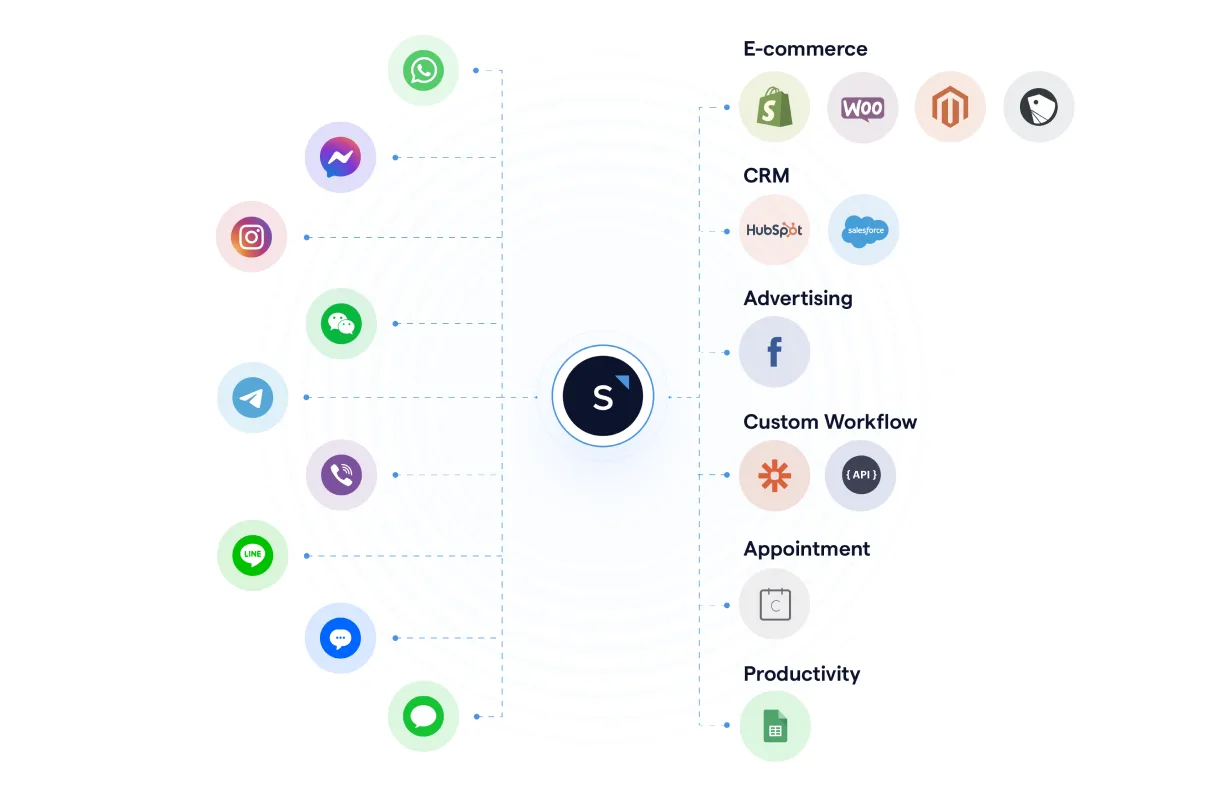
When it comes to implementing customer support automation for an omnichannel customer experience, businesses in the UAE can rely on SleekFlow as their trusted software solution. SleekFlow offers a comprehensive suite of features designed to streamline customer engagement automation and deliver a seamless customer journey across multiple channels.
Key features of SleekFlow include:
Mobile app functionality: Stay connected on the go with the SleekFlow mobile app on Google Play Store or Apple App Store, managing customer interactions, responding to inquiries, and accessing real-time analytics from anywhere, anytime, for uninterrupted customer support.
Omnichannel communication integration: Seamlessly integrate various communication channels, including WhatsApp API, Instagram and live chaT, to ensure consistent support across channels.
Automated chatbots: Deploy AI chatbots for customer service that instantly respond to common customer queries, handle repetitive tasks, and escalate complex issues to human agents, optimizing efficiency and response times.
Centralized customer data: Consolidate customer data in SleekFlow's integration with your CRMsystem, gaining a holistic view of customer interactions across channels to deliver personalized and context-aware support.
Analytics and reporting: Access analytics and reporting features to gain insights into customer support performance, satisfaction levels, and response times, enabling data-driven decision-making and continuous improvement.
Unlock the potential of customer care automation and elevate your business in the competitive UAE market now.


